Advertising for Dental Practices in Australia
A comprehensive eLearning course on the rules, regulations, and best practices for compliant dental advertising.
This course is designed for dentists, dental specialists, practice owners, and marketing staff who manage advertising for dental practices in Australia. No prior knowledge of advertising regulation is required.
Estimated completion time: 1 to 2 hours
CPD eligibility: This course is eligible for 2 hours of non-clinical CPD under the Dental Board of Australia's continuing professional development framework.
Reference Documents & Source Material
This course draws on the following legislation, guidelines, policies, and research. Links open in a new tab.
The Regulatory Landscape
An overview of who regulates dental advertising in Australia and why it matters.
Learning Objectives
- Identify the key regulators and laws governing dental advertising in Australia
- Explain why dental advertising is more heavily regulated than general business advertising
- Recognise the broad definition of "advertising" under the National Law
- Describe the consequences of non-compliance
If you own or work in a dental practice in Australia, advertising your services is a normal and necessary part of running a business. But unlike many other industries, healthcare advertising, including dental advertising, is heavily regulated. Multiple laws, regulators, and professional bodies set strict boundaries on what you can and cannot say when promoting your practice.
This module gives you the big picture: who are the regulators, what laws apply, and what the consequences are for getting it wrong.
Why Is Dental Advertising Regulated?
Regulation exists to ensure that advertising is honest, evidence-based, and does not exploit the information imbalance between practitioner and patient.Health Practitioner Regulation National Law, Preamble
The core reason is public protection. Dental services are health services, and patients often lack the technical knowledge to evaluate clinical claims. If a practice advertises misleadingly (for example, by promising pain-free results or showing unrealistic before-and-after photos), a patient may make decisions about their care based on false expectations.
The Key Regulators and Laws
Dental advertising in Australia is governed by a layered regulatory framework. There is no single law or body that covers everything. Instead, several pieces of legislation and multiple organisations work together.
This is the primary legislation governing health practitioner advertising in Australia. It applies uniformly across all states and territories (with minor variations in some jurisdictions). Section 133 is the key provision. It sets out five specific prohibitions on how a regulated health service may be advertised. We will examine Section 133 in detail in Module 2.
The National Law also establishes the framework for AHPRA and the National Boards (including the Dental Board of Australia), giving them the power to publish advertising guidelines and take enforcement action.
AHPRA is the national agency responsible for implementing the National Regulatory Scheme across Australia. In the context of advertising, AHPRA's role includes publishing advertising guidelines to help practitioners understand their obligations, receiving and investigating complaints about non-compliant advertising, and taking enforcement action (from issuing warnings through to prosecuting offences in court).
AHPRA published updated advertising guidelines that took effect on 2 September 2025. These are the most current guidelines and are a major focus of this course.
The Dental Board is one of the National Boards established under the National Law. Its role is to regulate the dental profession, including setting registration standards, codes of conduct, and, critically, approving guidelines for advertising of dental services. The Board's "Guidelines for advertising a regulated health service" sit alongside the AHPRA guidelines and are directly relevant to every dental practitioner.
The ADA is the peak professional body for dentists in Australia. While it does not have regulatory or enforcement powers under the National Law, it publishes important policy statements that guide professional conduct. Policy Statement 6.9: Advertising in Dentistry and Policy Statement 6.24: Social Media and Dentistry are particularly relevant. ADA members are expected to comply with these policies in addition to the law.
Dental practices are businesses, and their advertising must also comply with Australian Consumer Law. Section 18 of the ACL prohibits conduct that is misleading or deceptive, or likely to mislead or deceive, in trade or commerce. This is enforced by the ACCC (Australian Competition and Consumer Commission) and state/territory fair trading bodies. Importantly, intention is not required, even an honest mistake can breach the ACL if the advertising is objectively misleading.
The Therapeutic Goods Administration regulates the advertising of therapeutic goods (including certain dental products). For example, teeth whitening products above certain concentrations are classified as therapeutic goods. Advertising claims about these products must comply with the Therapeutic Goods Advertising Code. The TGA is particularly relevant if your practice sells or promotes specific branded products.
Think of it this way: the National Law sets the floor. The minimum legal requirements every dental practitioner must meet. AHPRA and the Dental Board guidelines interpret and expand on those requirements. The ADA policies establish professional standards that frequently exceed minimum regulatory requirements. And the Australian Consumer Law provides an additional, overlapping layer that catches any misleading conduct, even conduct that might technically comply with the National Law.
A single advertisement could potentially breach multiple laws simultaneously.
The Regulatory Hierarchy
✓ Regulated Advertising
- Evidence-based clinical claims
- Honest testimonials (non-clinical)
- Clear service descriptions
- Transparent pricing
- Proper credentials disclosure
✗ Non-Regulated Examples
- Private clinical consultations
- Internal staff communications
- Non-promotional conversations
- Patient education materials (when not promoting services)
- Purely medical notes/records
The National Law applies as adopted legislation across all Australian states and territories. However, there are minor jurisdictional variations, for example, Queensland operates under a co-regulatory model where complaints about advertising may also be handled by the Queensland Office of the Health Ombudsman. This course covers the national framework. If you practise in a specific state or territory, check whether additional local requirements apply to your advertising.
What Counts as "Advertising"?
The National Law's definition of "advertising" is so broad that internal staff newsletters promoting new services and appointment reminder messages that include promotional content can both be considered advertising and must comply with Section 133.
One of the most common mistakes practitioners make is thinking that "advertising" only means paid ads. Under the National Law, the definition is much broader. Advertising includes any form of communication that promotes a regulated health service, regardless of the medium. This includes:
| Medium | Examples |
|---|---|
| Websites | Practice website pages, blog posts, service descriptions, team bios |
| Social media | Facebook posts, Instagram stories, TikTok videos, LinkedIn articles |
| Print materials | Brochures, flyers, business cards, letterheads |
| Signage | Practice signs, window displays, vehicle wraps |
| Directory listings | Yellow Pages, Google Business Profile, health directories |
| Paid advertising | Google Ads, Facebook Ads, newspaper/magazine ads, radio spots |
| Email/SMS | Marketing emails, recall messages with promotional content |
| Third-party content | Marketing done by agencies on your behalf, sponsored content |
You are responsible for all advertising of your practice, even if it is created by a marketing agency, web designer, or social media manager. Outsourcing your marketing does not outsource your legal obligations. If a third party creates non-compliant advertising on your behalf, you are liable.
Consequences of Non-Compliance
The penalties for non-compliant advertising are significant and have increased over time:
| Consequence | Details |
|---|---|
| Financial penalties (National Law) | Up to $60,000 per offence for individuals; up to $120,000 per offence for bodies corporate. These increased penalties were introduced by the 2022 amendments to the National Law and have applied across all jurisdictions (including Western Australia) from July 2024. Previous penalties were significantly lower ($5,000/$10,000). |
| Financial penalties (ACL) | Potentially much higher. ACCC penalties can reach millions for serious breaches |
| Conditions on registration | AHPRA may place conditions on your registration, such as a ban on advertising |
| Professional sanctions | Registration restrictions or suspension for repeated or severe breaches |
| Prosecution | Serious cases may be referred to court |
| Reputational damage | Enforcement actions may be published by AHPRA, causing professional embarrassment |
Key Takeaways: Module 1
- Dental advertising is regulated by multiple overlapping laws and bodies: the National Law, AHPRA, the Dental Board, the ADA, the ACL/ACCC, and the TGA.
- "Advertising" has a very broad definition. It includes websites, social media, signage, directories, and any communication that promotes your services.
- You are personally responsible for all advertising, even when outsourcing to agencies.
- Penalties are substantial: up to $60,000 per offence for individuals and $120,000 for corporates under the National Law, with additional exposure under consumer law.
The National Law: Section 133
The legal foundation: understanding the five advertising prohibitions.
Learning Objectives
- List the five advertising prohibitions in Section 133 of the National Law
- Explain who Section 133 applies to (not just registered practitioners)
- Understand how courts use the AHPRA/Dental Board guidelines
Section 133 of the Health Practitioner Regulation National Law is the single most important piece of legislation governing dental advertising in Australia. Every dental practitioner, and every person who creates advertising for a dental practice, must understand it.
This section applies to anyone who advertises a regulated health service, not just registered practitioners, but also practice managers, marketing agencies, and anyone else involved in creating or publishing the advertising.
The Five Prohibitions
Section 133 states that a person must not advertise a regulated health service, or a business that provides a regulated health service, in a way that:
"Is false, misleading or deceptive or is likely to be misleading or deceptive."
This is the broadest prohibition. It catches not only statements that are outright false, but also those that are likely to mislead, even if technically true. For example, stating "painless dentistry" could be misleading because not all dental procedures are painless for all patients, even with anaesthesia.
"Offers a gift, discount or other inducement to attract a person to use the service or the business, unless the advertisement also states the terms and conditions of the offer."
You can offer discounts and promotions, but only if you clearly state the full terms and conditions. A social media post saying "50% off whitening this month!" without any further details would breach this provision.
"Uses testimonials or purported testimonials about the service or business."
This is a broad ban. The law prohibits the use of testimonials or purported testimonials about the service or business in advertising. Note that the statutory wording covers testimonials about the business itself, not only clinical outcomes. However, AHPRA's practical guidance clarifies that non-clinical "service experience" comments (about staff friendliness, wait times, facilities) are generally not caught by this prohibition. The focus is on testimonials that relate to clinical care or health outcomes. We cover this in depth in Module 5.
"Creates an unreasonable expectation of beneficial treatment."
Advertising must not lead people to expect results that cannot reasonably be guaranteed. For example, claiming "guaranteed straight teeth in 6 months" creates an unreasonable expectation because outcomes vary between patients.
"Directly or indirectly encourages the indiscriminate or unnecessary use of regulated health services."
Advertising should not pressure people into having procedures they may not need. For example, heavily promoting cosmetic procedures with urgency-based language ("limited time only! Transform your smile before summer!") could be seen as encouraging indiscriminate use.
Source: Jensen et al. (2023), Australian Dental Journal. Study of 192 general dental practice websites; Health Practitioner Regulation National Law (2022 amendments). In force across all jurisdictions from July 2024.
What Happens When AHPRA Investigates
Complaint or Routine Check
AHPRA receives a complaint from the public, another practitioner, or identifies an issue through routine advertising monitoring and compliance checks.
Evidence Gathered
Screenshots, website content, social media posts, and other advertising materials are collected and assessed against Section 133 requirements.
Practitioner Notified
You receive formal notification and are given an opportunity to respond, explain, or demonstrate compliance.
Outcome Determined
Outcomes range from a requirement to amend advertising, formal cautions, or enforceable undertakings, through to financial penalties and conditions on registration for serious or repeated breaches.
Compliant vs. Non-Compliant Website Examples
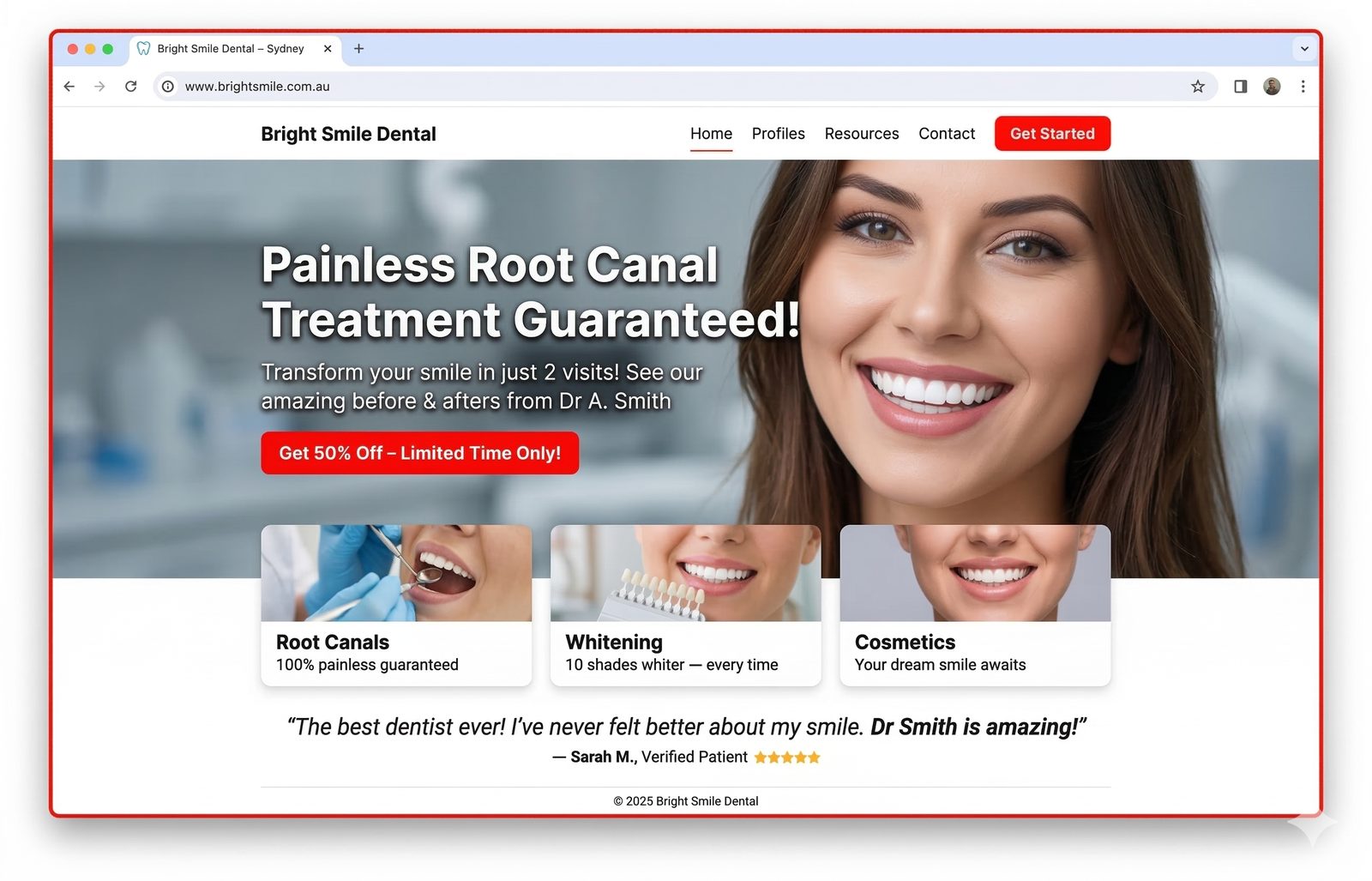
This website violates several regulations:
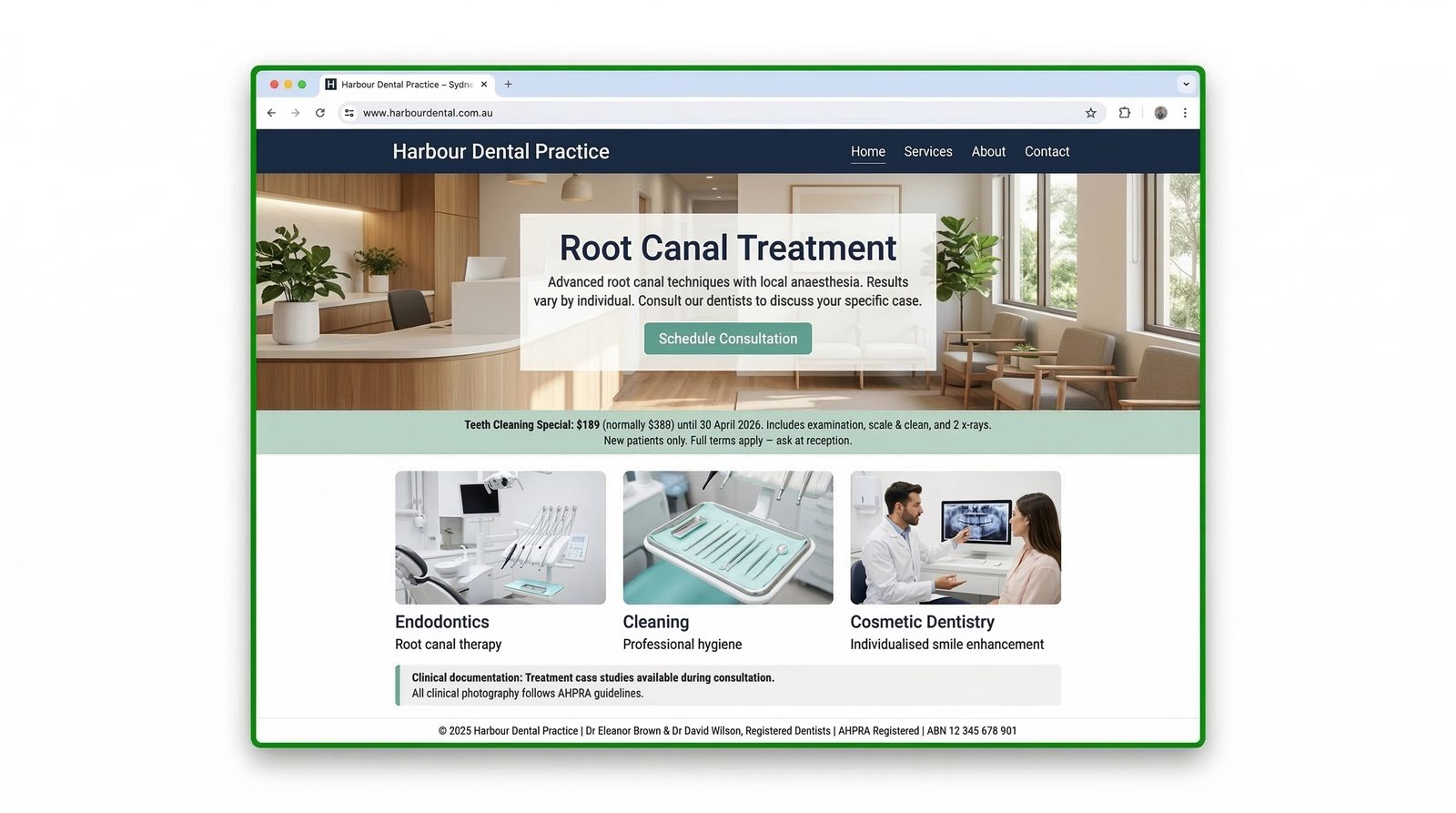
This revised version includes:
Who Does Section 133 Apply To?
A common misconception is that Section 133 only applies to registered dental practitioners. In fact, it applies to any person who advertises a regulated health service. This includes practice owners (whether or not they are registered practitioners), marketing agencies hired by a dental practice, web developers who build practice websites, social media managers who post on behalf of the practice, and reception staff who create flyers or window displays.
If a dental practice is operated as a company (Pty Ltd), the company itself can be fined up to $120,000 per offence. Directors and officers can also be held personally liable if they were knowingly involved in the contravention.
How Courts Use the Guidelines
The National Law states that in proceedings for an offence against Section 133, a court may have regard to guidelines approved by a National Board. This means the AHPRA and Dental Board advertising guidelines are not just helpful suggestions. They can be used by a court as a benchmark for whether advertising is compliant. If your advertising breaches the guidelines, a court is likely to find it also breaches the law.
Key Takeaways: Module 2
- Section 133 contains five specific prohibitions: false/misleading, inducements without T&Cs, testimonials, unreasonable expectations, and encouraging unnecessary use.
- The law applies to anyone who creates or publishes dental advertising, not just registered practitioners.
- Penalties are up to $60,000 for individuals and $120,000 for bodies corporate per offence.
- Courts may refer to AHPRA/Dental Board guidelines when deciding whether advertising breaches Section 133.
AHPRA Advertising Guidelines
Understanding the detailed guidance that interprets and expands on the National Law.
Learning Objectives
- Describe the evidence standard required for advertising claims
- Identify what practitioner information must be included in advertising
- Explain the September 2025 restrictions on cosmetic procedure advertising
- Understand AHPRA's enforcement approach
While Section 133 of the National Law sets the legal prohibitions, the AHPRA advertising guidelines provide the detailed, practical guidance on how those prohibitions should be interpreted and applied. Updated guidelines took effect on 2 September 2025, and they represent the most current authoritative interpretation of dental advertising obligations in Australia.
These guidelines are not optional guidance. As noted in Module 2, a court may refer to them when determining whether advertising breaches the law. Treating them as the practical rulebook for your advertising is the safest approach.
What the Guidelines Cover
The AHPRA advertising guidelines provide direction on several critical areas. Let's work through each one.
1. Evidence Standards for Advertising Claims
Any clinical claim you make in advertising must be supported by acceptable evidence. There is an important distinction between what is appropriate in a clinical consultation and what is appropriate in advertising. In a clinical setting, you obtain informed consent and discuss individual treatment options with your patient. In advertising, your audience is the general public. They have no opportunity to ask questions or receive personalised information.
For this reason, the evidence standard is HIGHER
AHPRA and the National Boards assess advertising claims using standards consistent with those used by the wider scientific and academic community.
Use Primary Sources
Peer-reviewed research should be used wherever possible, rather than secondary sources or marketing materials.
Document Your Evidence
Keep records of the evidence supporting each clinical claim, in case AHPRA asks you to justify it.
Before making any clinical claim in your advertising, ask yourself: "Could I produce a peer-reviewed journal article or clinical guideline that supports this claim?" If the answer is no, rephrase or remove the claim.
2. Identification Requirements
All advertising of regulated health services must clearly identify the practitioner providing the service. Specifically, your advertising must include the practitioner's name, their profession (e.g., "dentist", "dental hygienist"), their registration type and, where relevant, any division or endorsement on their registration.
This allows consumers to verify a practitioner's registration on the AHPRA register and make informed decisions about their care.
3. Cosmetic Procedure Advertising (September 2025 Updates)
The September 2025 updates introduced particularly strict rules for advertising cosmetic procedures, which is directly relevant to dental practices that offer services such as teeth whitening, veneers, or facial aesthetics.
- No influencer endorsements: dental clinics can no longer use patients, influencers, or brand ambassadors to promote cosmetic treatments
- No product brand names in consumer advertising. Words like "Botox", "Juvederm", or specific whitening product brands must not appear in advertising. Use general, factual wording instead.
- No advertising to minors: advertising cosmetic procedures to individuals under 18 is prohibited, including images of minors in cosmetic-related content
- No trivialising: advertising must not trivialise cosmetic procedures or present them as routine or risk-free
4. Risk-Based Enforcement
AHPRA follows a risk-based approach when assessing advertising complaints. They consider the potential for harm to patients, the extent to which the advertising is misleading, whether the breach appears deliberate or accidental, and any history of previous non-compliance. In most cases, a practitioner found to be non-compliant will be given 30 days to correct the issue. However, serious or repeated breaches can result in immediate conditions on registration or prosecution.
"Dr C. Taylor offers general and cosmetic dental services including porcelain veneers and professional teeth whitening. Results vary between patients. A consultation is required to determine suitability. Dr C. Taylor is a registered dentist (Dental Board of Australia)."
"Get your dream smile with our Zoom whitening system! Amazing results every time. Just ask our hundreds of happy patients! Book now and get 20% off."
The AHPRA Advertising Compliance and Enforcement Strategy
AHPRA's enforcement strategy is graduated and proportionate. The typical pathway is:
| Stage | Action |
|---|---|
| 1. Notification | AHPRA contacts the advertiser to advise of the issue and request correction |
| 2. Correction period | Usually 30 days to bring advertising into compliance |
| 3. Follow-up | AHPRA checks whether the issue has been resolved |
| 4. Escalation | If unresolved: conditions on registration, further investigation, or referral for prosecution |
| 5. Prosecution | Court action with penalties of up to $60,000 (individual) or $120,000 (body corporate) |
Source: Jensen et al. (2023), "Advertising and general dental practice: how compliant are practice websites in Australia with legal requirements?", Australian Dental Journal. Audit of 192 general dental practice websites.
Real-World Social Media Examples
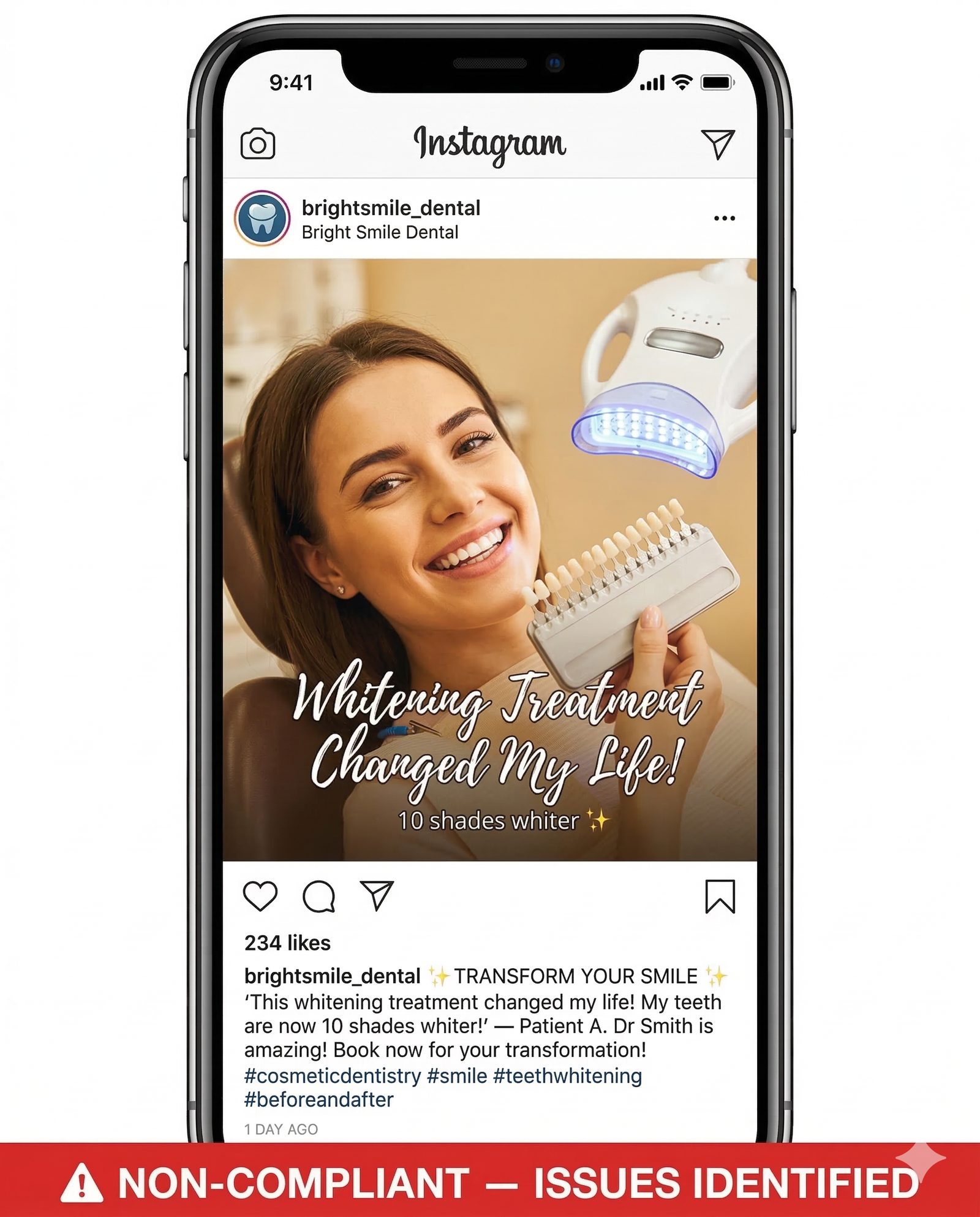
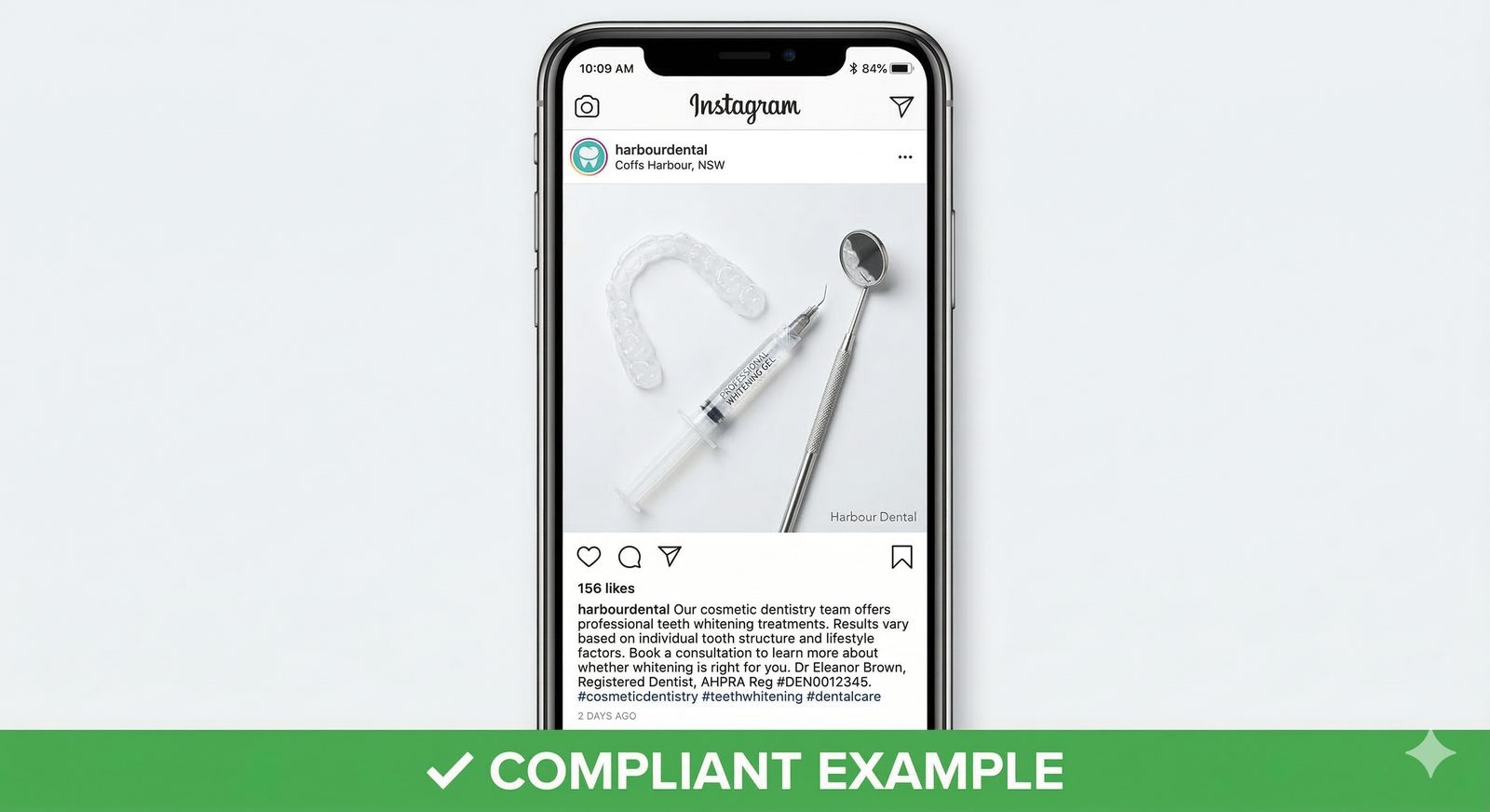
AHPRA takes into account cooperativeness and willingness to correct issues promptly. If you receive a notification, responding quickly and making genuine efforts to fix the issue will typically result in a more favourable outcome.
The AHPRA advertising guidelines require that any clinical claim in your advertising must be supported by __________. This standard is higher for advertising than for clinical decision-making because your audience is the __________ rather than individual patients with informed consent. Under the September 2025 updates, advertising of cosmetic dental procedures is now strictly regulated, with prohibitions on __________ and the use of __________ in advertising.
Key Takeaways: Module 3
- The AHPRA advertising guidelines provide the practical detail behind Section 133. Treat them as your rulebook.
- All clinical claims must be supported by acceptable scientific evidence. The standard is higher for advertising than for clinical consultations.
- Advertising must clearly identify the practitioner, their profession, and their registration details.
- The September 2025 updates introduced strict new rules for cosmetic procedure advertising: no influencers, no product brand names, no advertising to minors, and no trivialising.
- AHPRA uses a graduated enforcement approach, but cooperation and prompt correction are important mitigating factors.
Dental Board & ADA Requirements
Profession-specific advertising standards from the Dental Board of Australia and the Australian Dental Association
Learning Objectives
- Understand the Dental Board of Australia's role in setting advertising standards for dental practitioners
- Identify key ADA policy positions on dental advertising (Policies 6.9 and 6.24)
- Distinguish between mandatory regulatory requirements and voluntary professional guidelines
- Apply Dental Board and ADA requirements to common dental advertising scenarios
The Dental Board of Australia
The Dental Board of Australia operates under the National Registration and Accreditation Scheme alongside AHPRA. While AHPRA enforces the National Law (including Section 133 on advertising), the Dental Board sets profession-specific standards, codes, and guidelines that dental practitioners must follow.
Dental Board's Role in Advertising
The Dental Board does not publish a separate advertising code. Instead, it relies on AHPRA's advertising guidelines while setting profession-specific expectations through its Code of Conduct and registration standards. Key areas that intersect with advertising include:
- Scope of practice: You must not advertise services outside your scope of practice or competency
- Specialist registration: Only practitioners with specialist registration can use specialist titles (covered in detail in Module 6)
- Continuing Professional Development (CPD): Claims about expertise should be supported by genuine ongoing education and training
- Informed consent: Advertising must not undermine a patient's ability to make informed decisions about their care
Dental Board Code of Conduct: Advertising Relevance
The Dental Board's Code of Conduct for registered health practitioners contains several provisions directly relevant to advertising:
The Code requires practitioners to maintain professional boundaries in all interactions with patients and the public. In advertising, this means:
- Avoiding marketing that creates unnecessary anxiety or fear about dental conditions
- Not using pressure tactics or urgency-based messaging that could exploit vulnerable patients
- Ensuring all advertising maintains the dignity and trust of the profession
- Not making claims that could be seen as taking advantage of a patient's lack of dental knowledge
Practitioners must provide information that is factual, accurate, and not misleading. In advertising, you must:
- Only claim qualifications and experience that you actually hold
- Not overstate the benefits or likely outcomes of treatments
- Include relevant risks or limitations when describing procedures
- Ensure claims about technology, techniques, or materials are verifiable
The Code requires practitioners to be transparent about costs. When advertising pricing:
- Advertised prices must reflect the actual cost patients will pay
- Any conditions, exclusions, or additional fees must be clearly stated
- "From" pricing must genuinely reflect a realistic starting price
- Payment plans and financing arrangements must be transparent about total cost and any interest
The Australian Dental Association (ADA)
The ADA is the peak professional body for dentists in Australia. Unlike AHPRA and the Dental Board, the ADA is a voluntary membership organisation. its guidelines are not legally binding unless they reflect existing law. However, ADA policy positions carry significant professional weight and represent best-practice standards.
Voluntary (ADA): Best-practice standards that represent professional ideals. Non-compliance alone does not trigger regulatory penalties, but following them demonstrates professional commitment and often exceeds minimum legal requirements.
ADA Policy Statement 6.9: Advertising
ADA Policy 6.9 sets out the Association's position on dental advertising. Key principles include:
- Truthful and not misleading: All advertising must be factually accurate and verifiable
- Not comparative: The ADA discourages advertising that directly compares your services against other practitioners or practices
- Professional dignity: Advertising should maintain the dignity and reputation of the dental profession
- Patient interest: Advertising should primarily serve the information needs of patients, not just commercial interests
- No exploitation: Advertising must not exploit patients' fears, anxieties, or lack of dental knowledge
The ADA accepts that price advertising is permitted but emphasises:
- Prices must be accurate and inclusive of all necessary costs for the advertised service
- Discounts and special offers must be genuine and not create unreasonable expectations
- Price-based advertising should not compromise the quality of care delivered
- Pricing should be transparent, with any conditions clearly stated upfront
ADA Policy Statement 6.24: Social Media
Recognising the growing use of digital platforms, the ADA has issued guidance specifically on social media use by dental practitioners:
ADA Social Media Guidelines
- Professional boundaries: Maintain clear professional boundaries when interacting with patients on social media platforms
- Patient privacy: Never share patient information, images, or case details without explicit, informed written consent
- Separation of personal and professional: Consider maintaining separate personal and professional social media accounts
- Monitoring: Regularly monitor your social media presence, including comments and reviews, for compliance issues
- Team awareness: Ensure all practice staff understand social media obligations and have clear social media policies
How Dental Board & ADA Requirements Interact with AHPRA
| Aspect | Dental Board / AHPRA (Mandatory) | ADA (Voluntary Best Practice) |
|---|---|---|
| Authority | Statutory body under the National Law | Voluntary peak professional body |
| Key Instruments | National Law (Section 133), Code of Conduct, Scope of Practice, Registration Standards | Policy Statement 6.9 (Advertising), Policy Statement 6.24 (Social Media) |
| Binding? | Yes. Legally enforceable for all registered dental practitioners | No. Voluntary guidelines for ADA members, but reflect professional best practice |
| Penalties | Fines up to $60,000 (individual) / $120,000 (corporate), conditions on registration, suspension, cancellation | Professional censure, reputational consequences within the profession |
| Enforcement | AHPRA investigates complaints and takes regulatory action on behalf of the Dental Board | No enforcement power. Relies on professional reputation and peer standards |
| Scope of Practice | Must not advertise services outside your registered scope or competency | Encourages honest representation of skills and services |
| Comparative Advertising | Claims must be verifiable and not misleading (Section 133(1)(a)) | Specifically discourages all comparative advertising against other practitioners |
| Fee Advertising | Prices must be accurate, complete, and not misleading; offers require full T&Cs | Prices must be inclusive of all necessary costs; no compromise on care quality |
| Social Media | Same advertising rules apply to all digital platforms | Additional guidance on professional boundaries, patient privacy, and account separation (Policy 6.24) |
| Testimonials | Clinical testimonials banned in advertising (Section 133(1)(c)) | Supports the ban; encourages practices to manage online reputation within the law |
If your advertising complies with ADA best-practice standards, it will almost certainly meet the mandatory Dental Board/AHPRA requirements too, but not necessarily the other way around. Aim for ADA standards as your benchmark.
Pre-Publication Compliance Flowchart
Scenario: Advertising a New Service
Dr B. Jones wants to advertise that her practice now offers sleep dentistry (IV sedation). She has completed a weekend course on sedation techniques.
Scenario: Comparative Advertising
Dr C. Taylor's practice uses a newer type of digital scanner. He wants to advertise: "Our 3D scanner is more accurate than the outdated equipment used by other local dentists."
Practical Compliance Checklist
Before Publishing Any Advertisement, Check:
- Does the ad only promote services within your registered scope of practice?
- Are all qualifications and credentials accurately stated?
- Is the pricing complete and transparent?
- Does the ad avoid making comparative claims against other practitioners?
- Would the Dental Board consider this consistent with professional conduct?
- Does it meet AHPRA's advertising requirements (Section 133 compliance)?
- Would the ADA consider this consistent with professional dignity?
Testimonials, Reviews & Social Media
Understanding the statutory testimonial ban, managing online reviews, and navigating social media compliance
Learning Objectives
- Understand the scope and application of the statutory testimonial ban under Section 133
- Distinguish between prohibited testimonials and permissible patient feedback
- Navigate online review management within the regulatory framework
- Apply social media compliance principles to common dental marketing activities
The Statutory Testimonial Ban
Section 133 of the Health Practitioner Regulation National Law includes an explicit prohibition on testimonials in advertising. This is one of the most significant and most commonly misunderstood aspects of dental advertising regulation in Australia.
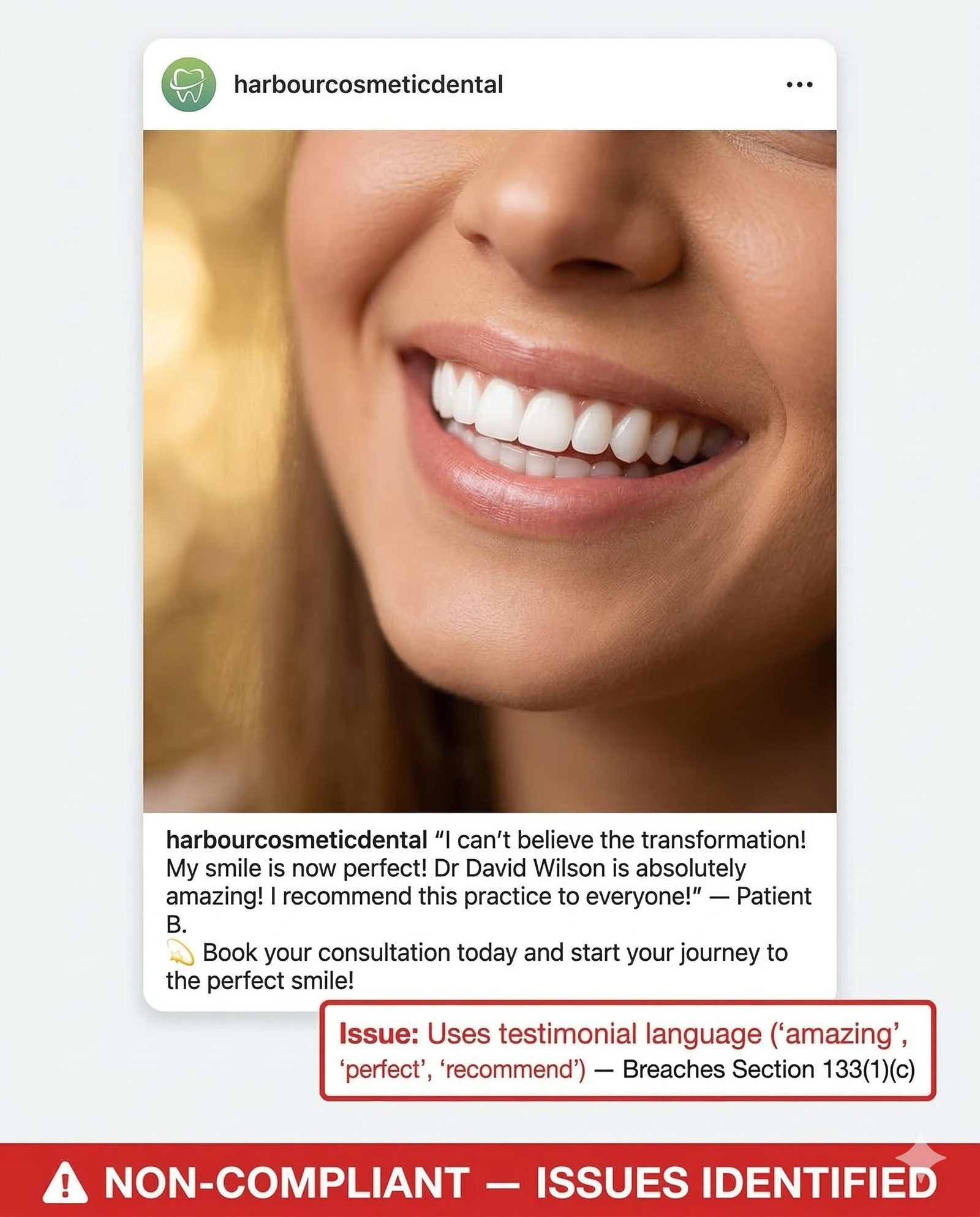
Section 133(1)(c) provides that a person must not advertise a regulated health service, or a business that provides a regulated health service, in a way that "uses testimonials or purported testimonials about the service or business".
Note: The statutory wording covers testimonials about both the clinical service and the business itself. This is broader than many practitioners realise. It's not limited to clinical testimonials. However, AHPRA's practical enforcement guidance has focused primarily on testimonials about clinical aspects of care, while noting the statute's broader reach.
What Counts as a Testimonial?
AHPRA defines a testimonial broadly as any statement that could be perceived as a recommendation or positive endorsement of a regulated health service or practitioner, regardless of whether the person giving it is identifiable or anonymous.
- "Dr F. Martin gave me the best smile of my life!" (on your website)
- Patient video testimonials embedded on practice pages
- Star ratings with patient comments featured in your advertising
- "I highly recommend ABC Dental" (quoted in practice brochures
- Before-and-after photos paired with patient endorsement quotes
- Sharing a patient's positive Google review on your Facebook page
- Screenshots of positive patient messages used in marketing material
- Google/Facebook Reviews on your listing: The reviews themselves on third-party platforms are not within your direct control. However, you must not use those reviews in your advertising (e.g., quoting them on your website, featuring screenshots in ads, or linking to them with "See what our patients say!")
- "Like and share" campaigns: Encouraging patients to share positive experiences on social media can be seen as soliciting testimonials for advertising purposes
- Case studies: Detailed descriptions of treatment outcomes can cross into testimonial territory if they include patient endorsement language
- Influencer partnerships: Paying or providing free treatment to an influencer who then posts about it is using a testimonial in advertising
- Respond to reviews professionally: You can thank reviewers and respond to negative reviews (while maintaining patient privacy)
- Let reviews exist organically: Reviews on third-party platforms that you haven't solicited or featured are generally outside the ban
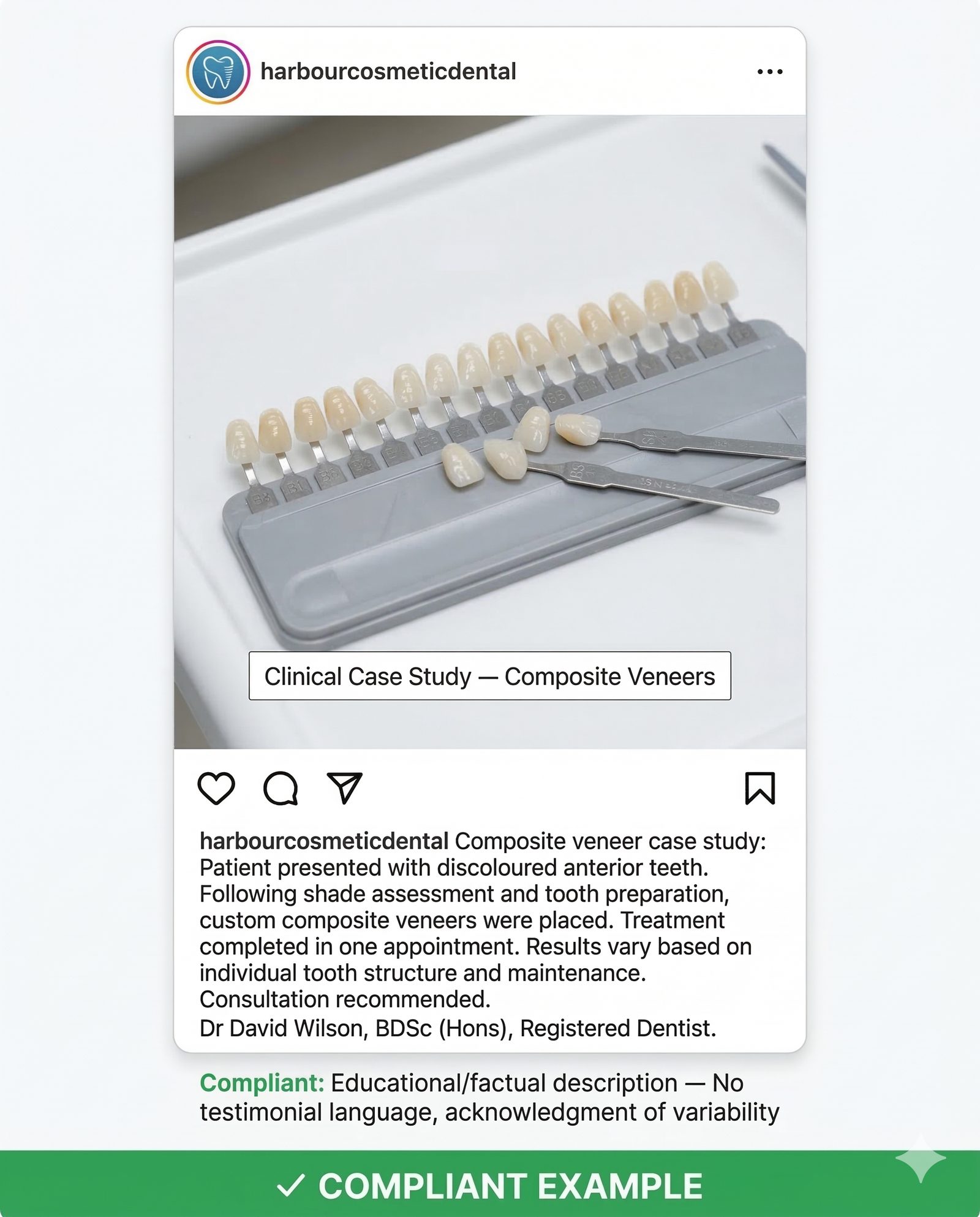
- Factual case descriptions: You can describe treatment processes factually without including patient endorsement language (e.g., "This case involved orthodontic treatment over 18 months", without "and the patient was thrilled")
- Practice information: Statements about your practice hours, services, location, team qualifications, and technology are fine
- Educational content: Creating genuinely educational content about dental health conditions and treatments is encouraged
Managing Online Reviews
Online reviews are a reality of modern practice. The key is understanding how to manage them without breaching advertising obligations.
The Review Management Framework
Reviews on third-party platforms (Google, Facebook, Healthshare, etc.) that are posted organically by patients are generally not considered "advertising" by the practice. You didn't create, solicit, or control them. However, the moment you use those reviews in your own marketing, they become testimonials in your advertising.
You can respond to positive reviews, but keep it professional and avoid turning your response into further advertising:
- Do: "Thank you for your kind feedback. We're glad you had a positive experience."
- Don't: "Thanks! We pride ourselves on being the best cosmetic dentists in [suburb]. Book your free consultation today!"
Also, never disclose any patient health information in your response, even if the patient mentioned their treatment in their review.
Negative reviews require particular caution due to patient confidentiality:
- Never confirm or deny that the person is a patient of your practice
- Never discuss any clinical details, even if the patient has disclosed them publicly
- Do provide a general response: "We take all feedback seriously. Please contact our practice directly so we can address your concerns."
- Do report fake or defamatory reviews to the platform
- Don't get into an argument. It's visible to every potential patient
Actively asking patients to leave positive reviews can create compliance risks:
- Directing patients to leave reviews could be seen as soliciting testimonials
- Offering incentives for reviews (discounts, free treatments) is clearly soliciting testimonials and also raises ACCC concerns about fake reviews
- Selective solicitation (only asking happy patients) can also breach Australian Consumer Law provisions on misleading conduct
- Safest approach: Do not specifically ask for reviews. Provide excellent care and let reviews happen naturally
Social Media Compliance
Social media presents unique challenges for dental advertising compliance because the line between personal sharing and practice advertising can be blurred.
The Golden Rule of Dental Social Media
If it's posted on a practice account, or by a practitioner in their professional capacity, and it promotes the practice or its services. It's advertising, and all the same rules apply. Instagram posts, Facebook updates, TikTok videos, LinkedIn articles. They're all "advertising" if they promote your regulated health service.
- Sharing patient before-and-after photos without proper consent documentation, even with consent, the post must comply with all advertising rules
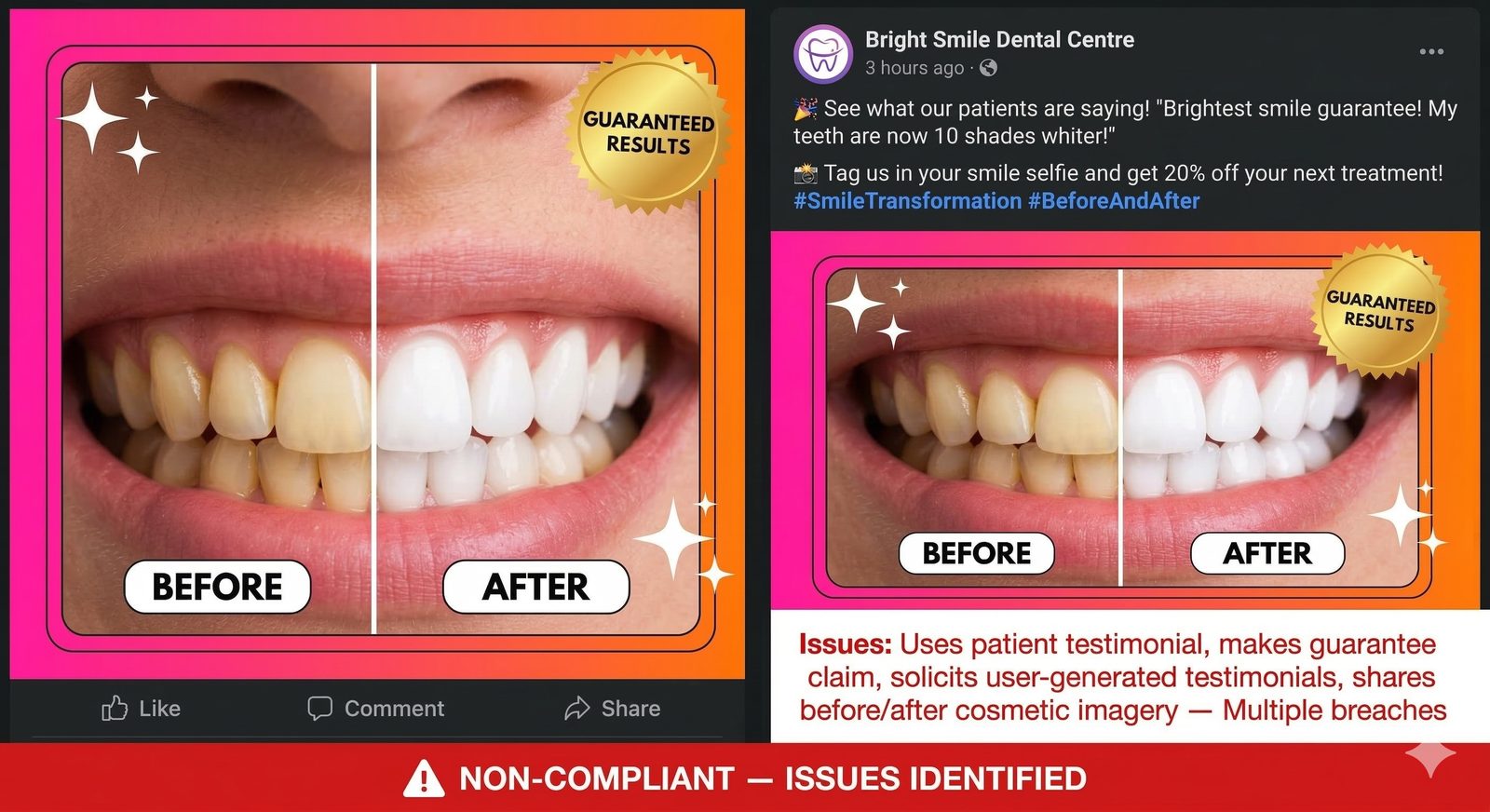
- Reposting patient "thank you" messages: this is using testimonials in advertising
- "Tag us in your smile selfie" campaigns. This can constitute soliciting testimonials
- Using clinical outcome claims in captions: "Guaranteed straight teeth in 6 months!" is both a guarantee (prohibited) and potentially misleading
- Influencer partnerships: Providing free or discounted treatment to influencers who post about it is using testimonials and must also comply with ACCC influencer marketing guidelines
- Staff posting about the practice: Practice staff social media posts that promote the practice are also advertising
You can use social media effectively while staying compliant. Focus on:
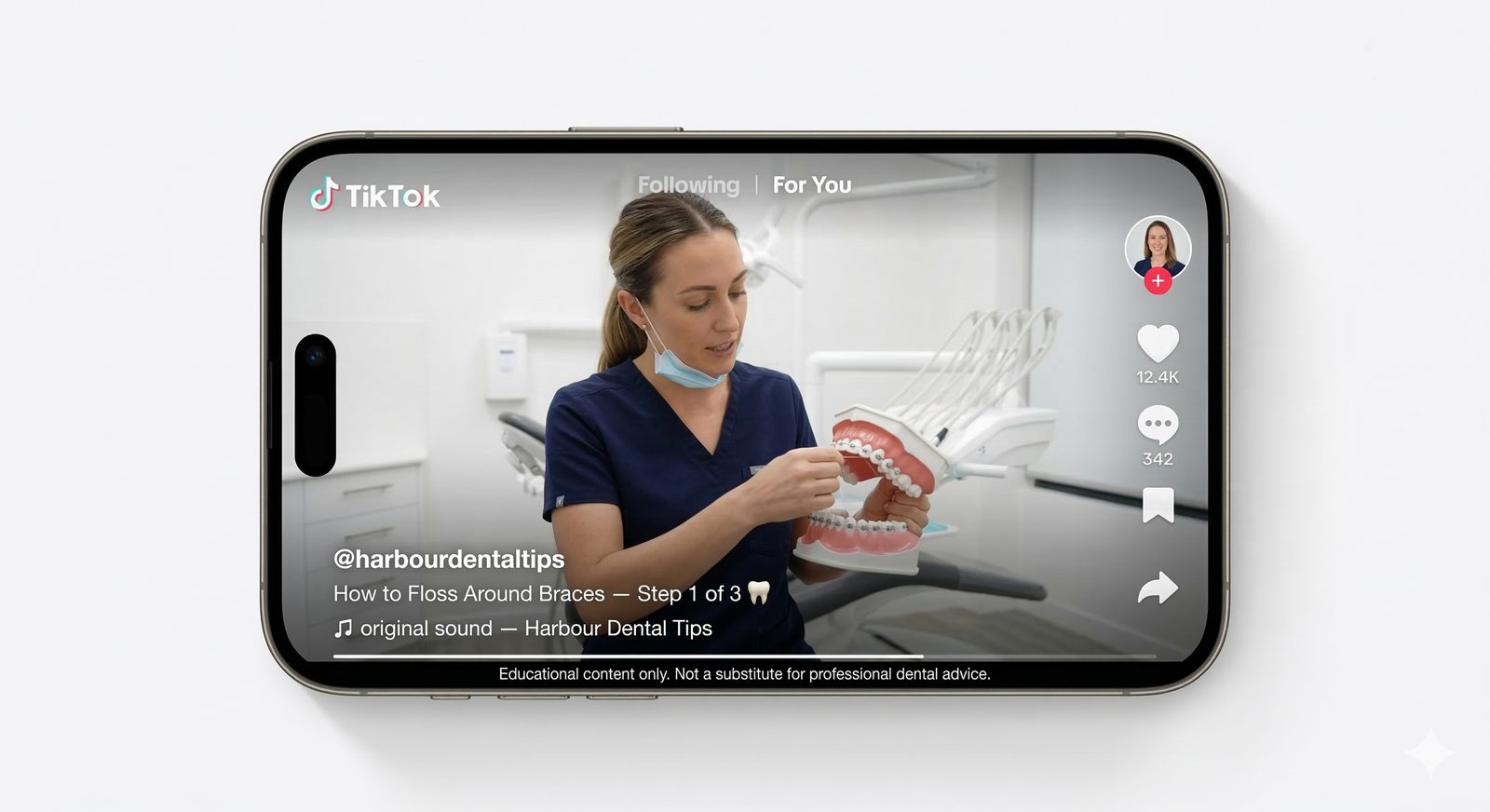
- Educational content: "Here's how to properly floss around braces" (genuinely helpful, not promotional)
- Practice updates: New equipment, extended hours, team introductions (factual information)
- Community involvement: Charity events, school visits, community health programs
- Behind-the-scenes: Day in the life of a dentist, practice tours, sterilisation processes (builds trust without testimonials)
- Public health messaging: Oral health awareness, dental health month content, preventive care tips
- Treatment education: How does a dental implant work? What happens during a root canal? (educational, not promotional)
Privacy obligations are especially critical on social media:
- Written consent is essential: Before posting any patient images, obtain specific written consent that covers the platform, context, and duration of use
- De-identification isn't always enough: Even if a face isn't visible, combining dental images with other details (treatment type, approximate date, location) can make patients identifiable
- Consent can be withdrawn: Patients have the right to withdraw consent at any time, and you must remove the content promptly
- Consider ongoing visibility: Social media posts can be reshared beyond your control. Discuss this with patients before posting
Practice Scenarios
Scenario: The Google Review Screenshot
Your practice has received a glowing 5-star Google review. Your practice manager wants to take a screenshot and post it on the practice's Instagram page with the caption "Our patients love us!"
Scenario: The Influencer Partnership
A local Instagram influencer with 50,000 followers approaches your practice offering to post about their teeth whitening experience in exchange for free treatment.
Scenario: The TikTok Treatment Video
Your associate dentist wants to create a TikTok showing a time-lapse of a composite veneer procedure, with the caption "Watch this amazing transformation! DM us for a free consult."
Social Media Post Examples
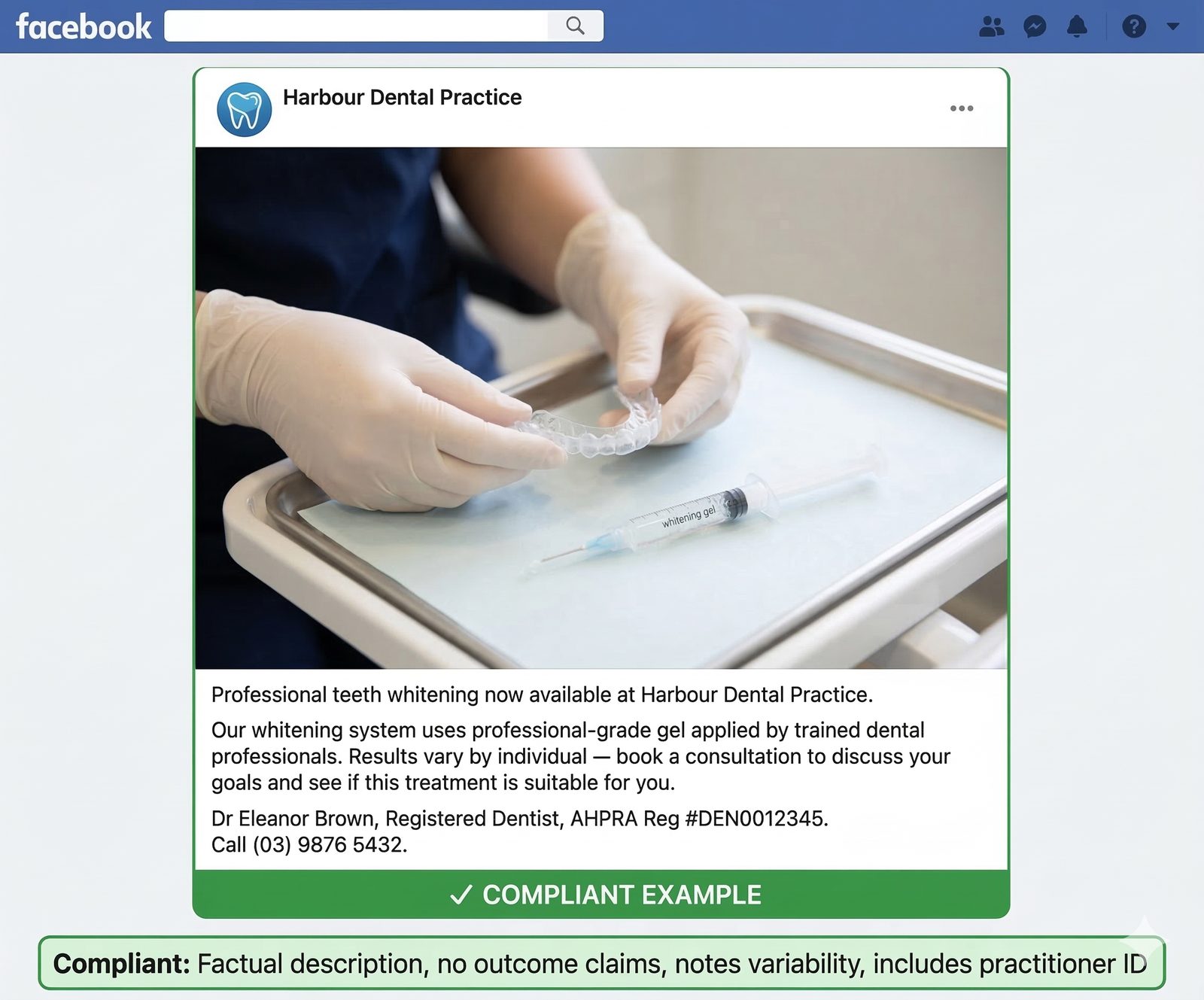
Review Response and Management Example
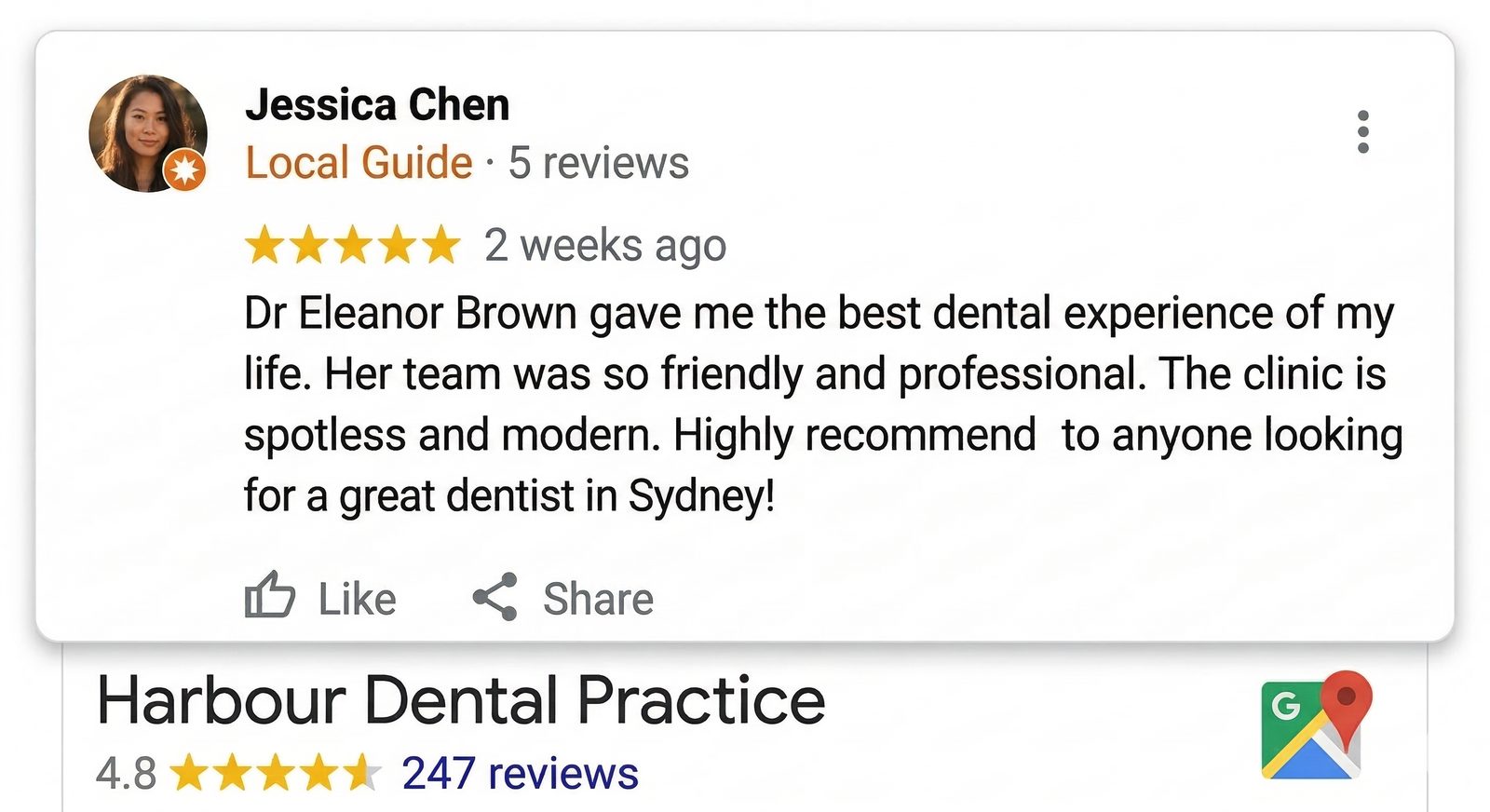
✓ Compliant Response to Positive Review
"Thank you for taking the time to share your feedback. We're pleased you had a positive experience at our practice. We look forward to seeing you again. - The team at Example Dental Practice"
Why this works: Professional, appreciative, no additional advertising claims, does not confirm or deny patient relationship, does not disclose clinical information.
✗ Non-Compliant Response to Positive Review
"Thanks Jessica! We pride ourselves on being the best dental practice in the area. Dr E. Brown specialises in cosmetic dentistry and would love to help you with whitening next time. Book online for 20% off your next visit! - Example Dental Practice"
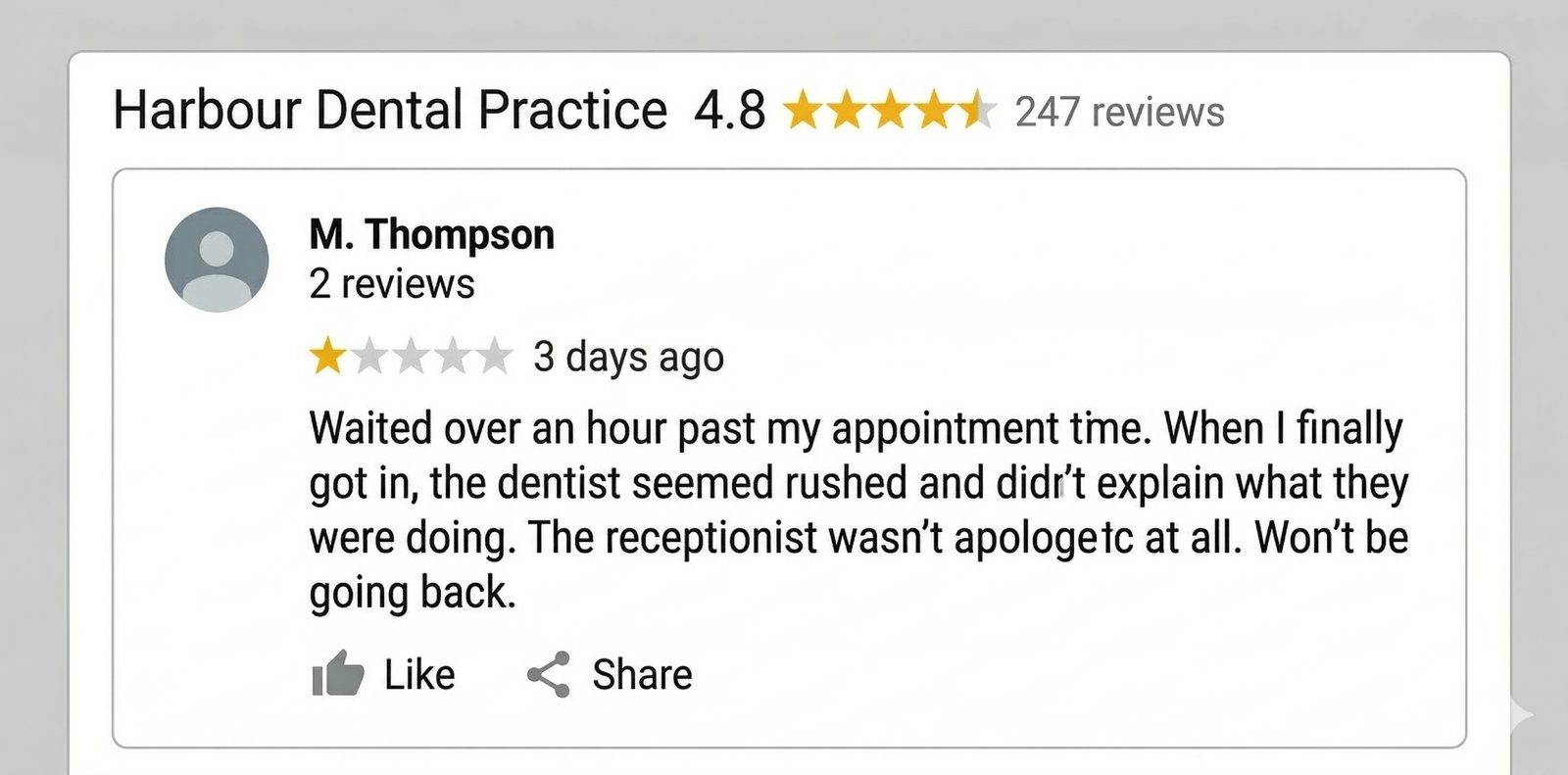
✓ Compliant Response to Negative Review
"Thank you for your feedback. We take all feedback seriously and strive to provide the best possible experience for everyone who visits our practice. We would welcome the opportunity to discuss your concerns. Please contact our practice on 03 0000 0000 so we can assist you. - Example Dental Practice"
Why this works: Does not confirm or deny the reviewer is a patient. Does not disclose any clinical details. Does not become defensive. Invites private follow-up. Professional and measured tone.
✗ Non-Compliant Response to Negative Review
"Hi M. Thompson, we're sorry about your experience on Tuesday. Your 45-minute composite filling appointment ran over because the previous emergency extraction took longer than expected. Dr E. Brown always explains procedures thoroughly. Perhaps there was a misunderstanding. We'd be happy to review your treatment plan if you call us."
Compliant TikTok/Reel Education Example
State & Territory Variation
While the National Law applies uniformly across Australia, some states and territories may have additional guidance or enforcement priorities regarding social media and advertising. Each state and territory co-regulatory body works with AHPRA on advertising enforcement. Check whether your jurisdiction has issued any local guidance notes. Always comply with the National Law as a minimum baseline.
Titles, Claims & Specialist Rules
Protected titles, specialist claims, and what you can and cannot call yourself in advertising.
Learning Objectives
- List the protected titles for dental practitioners and who may use them
- Explain the difference between "specialist" and "special interest" in advertising
- Describe the rules for using qualifications in advertising
- Apply the "Dr" title rules to different dental team members
How you describe yourself and your qualifications in advertising is tightly regulated. Using the wrong title or making unsupported claims about your expertise can result in serious consequences, including prosecution. This module covers the rules around professional titles and specialist claims in dental advertising.
Protected Titles
"Dentist" is a protected title under the National Law. This means it is unlawful for anyone who is not a registered dental practitioner to claim to be a dentist, use the title "dentist" in advertising, or hold themselves out as qualified to practise as a dentist.
The protected titles for dental practitioners are:
| Protected Title | Who Can Use It |
|---|---|
| Dentist / Dental Surgeon | Registered dentists only |
| Dental Hygienist | Registered dental hygienists |
| Dental Therapist | Registered dental therapists |
| Oral Health Therapist | Registered oral health therapists |
| Dental Prosthetist | Registered dental prosthetists |
| Dental Specialist | Practitioners with specialist registration in a recognised specialty |
✓ Correct Title Usage
- "Dr C. Taylor, Dentist"
- "Mark Wilson, Dental Hygienist"
- "Dr James Kumar, Specialist Orthodontist" (with specialist registration only)
- "Has special interest in implants"
- "Registered dental therapist"
✗ Incorrect/Misleading Titles
- "Dr" for dental hygienists/therapists
- "Specialist cosmetic dentist" (without specialist registration)
- "Dental specialist" (without specialist registration)
- "Specialises in implants" (without specialist credentials)
- "Dr C. Taylor, Specialist" (vague & potentially misleading)
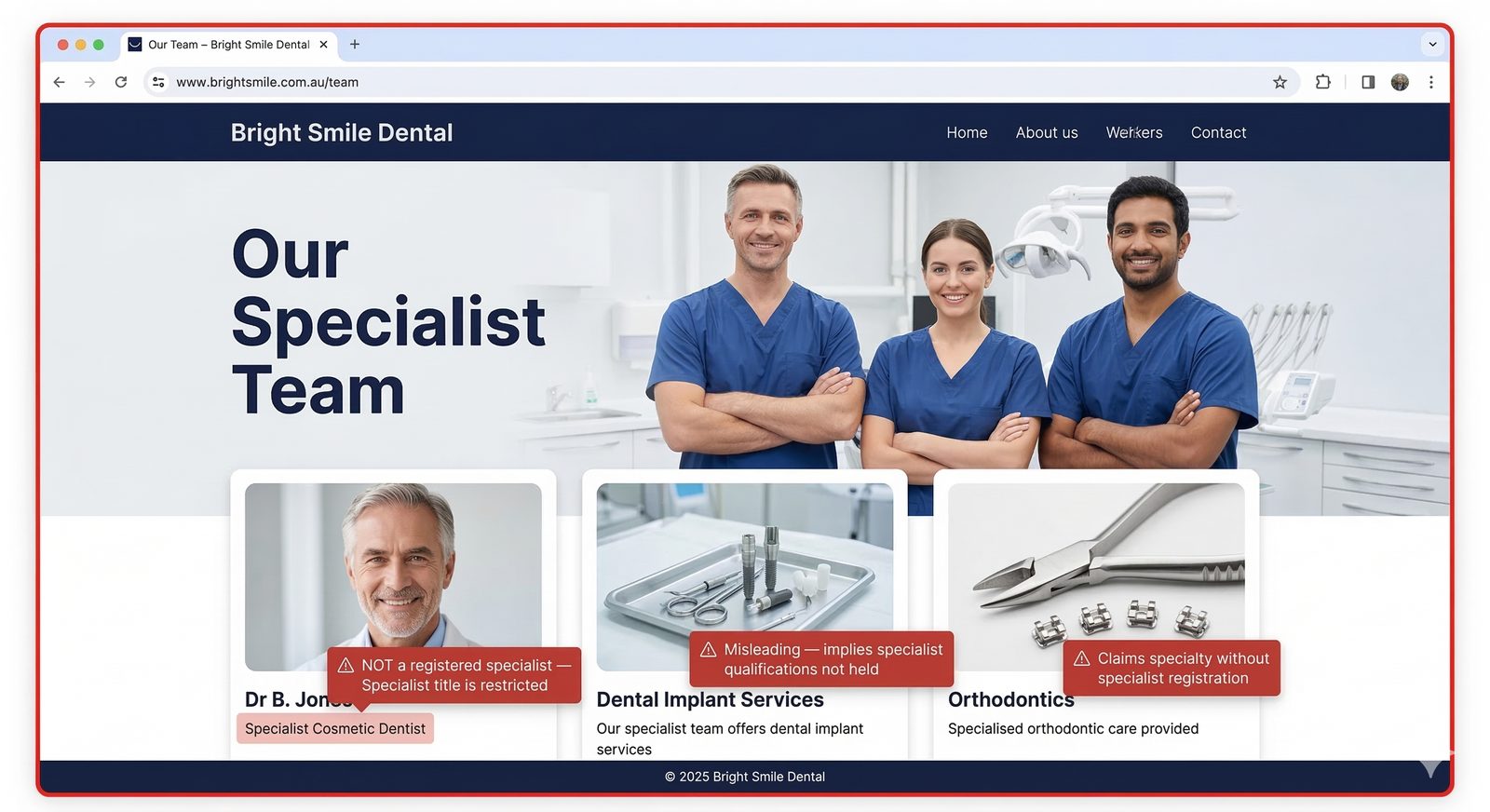
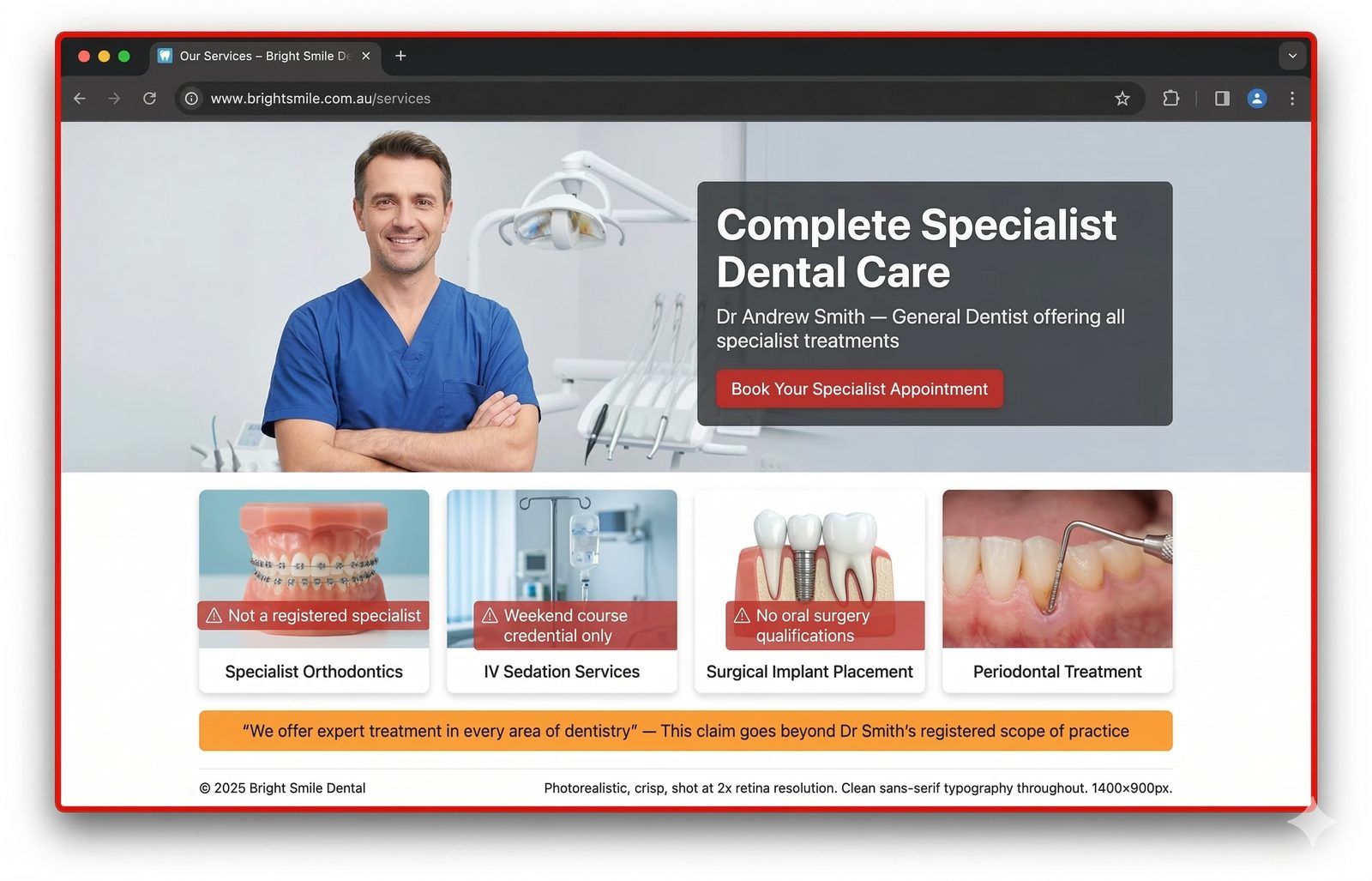
This webpage violates the specialist registration rules in four ways:
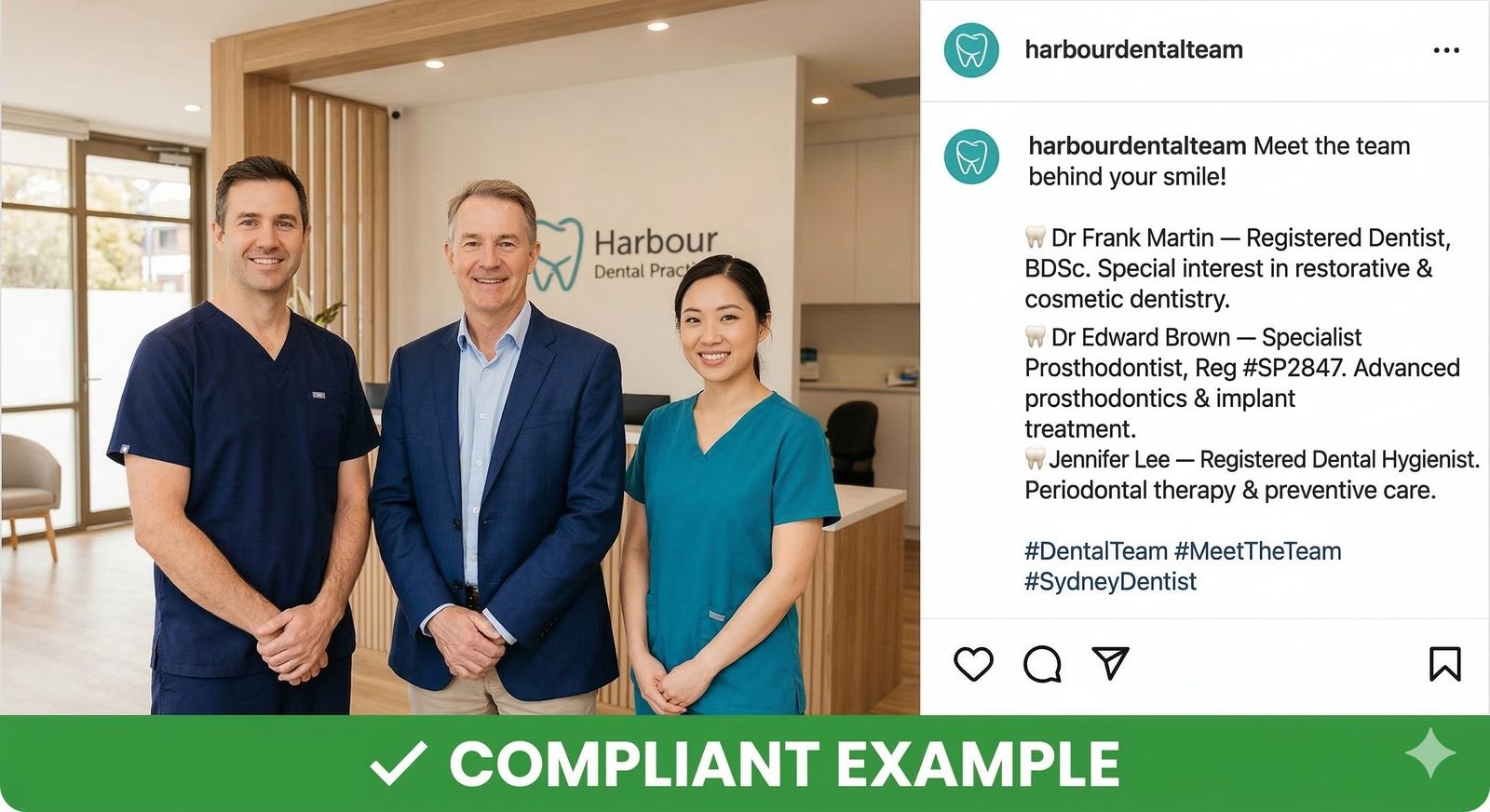
This team profile correctly identifies credentials:
Specialist vs. "Special Interest"
This is one of the most common areas of confusion and non-compliance. The rules are strict:
- "Specialist in cosmetic dentistry" (unless you hold specialist registration)
- "Specialises in implants"
- "Our specialist orthodontic services" (unless provided by a registered specialist orthodontist)
- Any variation of "specialist", "specialises in", "specialty", or "specialised"
- "Has a special interest in cosmetic dentistry"
- "Focuses on implant dentistry"
- "Has completed additional training in orthodontics"
- "Provides implant services"
- "Has extensive experience in paediatric dentistry"
The word "specialist" and its variations are reserved exclusively for practitioners who hold specialist registration with the Dental Board. Using these words without specialist registration is misleading and likely to breach Section 133.
Qualifications and Credentials in Advertising
You may list your qualifications in advertising, but there are guidelines on how to do this appropriately. Qualifications should be presented accurately and should not be used in a way that misleads the public about your scope of practice.
"Dr A. Smith, BDSc (Melb), Dentist. A. Smith has a special interest in restorative and cosmetic dentistry and has completed additional postgraduate training in dental implant placement."
"Dr A. Smith, BDSc, GradDipClinDent, MRACDS, FICD. Specialist in Cosmetic and Implant Dentistry"
The "Doctor" Title
Only dentists and specialist dentists should use "Dr" in dental advertising. Dental hygienists, dental therapists, oral health therapists, and dental prosthetists should not use "Dr" in the context of dental practice advertising, even if they hold a doctoral degree in another field.
Key Takeaways: Module 6
- Protected titles can only be used by practitioners with corresponding registration.
- "Specialist" is reserved for practitioners with specialist registration. Use "special interest" instead.
- Qualifications can be listed, but should not create a misleading impression of greater expertise.
- Only dentists and specialist dentists should use "Dr" in dental advertising.
Discounts, Offers & Inducements
How to promote special offers and discounts without breaching the law.
Learning Objectives
- State the legal requirement for terms and conditions when advertising offers
- Identify what must be included in terms and conditions
- Apply the rules to common promotional scenarios (referrals, free consultations, memberships)
- Recognise how consumer law adds additional requirements for pricing
Dental practices frequently run promotions. The good news is that the National Law does not ban these outright. The bad news is that getting the details wrong is a common source of non-compliance.
The Rule: Full Terms and Conditions Required
A 2023 audit of 192 dental practice websites found that 12.8% featured offers or inducements without complete terms and conditions. A direct breach of Section 133(1)(b). While not the most common breach type, it is one of the easiest to avoid: simply include clear T&Cs with every offer. (Source: Jensen et al. (2023), Australian Dental Journal)
Section 133 prohibits advertising that "offers a gift, discount or other inducement to attract a person to use the service or the business, unless the advertisement also states the terms and conditions of the offer."
- The specific services or products the offer applies to
- Any eligibility restrictions (e.g., "new patients only")
- The start date and end date of the offer
- Any limitations or exclusions
- The full price and the discounted price (or the value of the discount)
- Whether the offer can be combined with other promotions
- Any conditions that must be met to receive the offer
"New Patient Special: Comprehensive exam, scale and clean, and two bitewing x-rays for $199 (normally $350). Available to new patients only. Offer valid from 1 March to 31 March 2026. Not available with other offers. Additional treatment, if required, is not included and will be quoted separately."
"50% off whitening this month! Book now!"
Common Promotional Scenarios
"Refer a friend and you both receive a $50 credit". This is permissible, but only if you clearly state the full terms: what the credit can be used for, any expiry date, whether the referred friend must complete certain treatment, and any limits on the number of referrals.
Offering a free initial consultation is permitted, but you must be clear about what's included and what's not. If the "free consultation" only covers a brief visual assessment and not x-rays or a comprehensive examination, this must be stated. Otherwise, the advertising is misleading.
Dental membership plans (e.g., "$39/month for two check-ups, two cleans, and 15% off all other treatments") are inducements and must include comprehensive terms and conditions: what's included, exclusions, minimum commitment period, cancellation terms, and any caps on the discount.
Promotion Examples
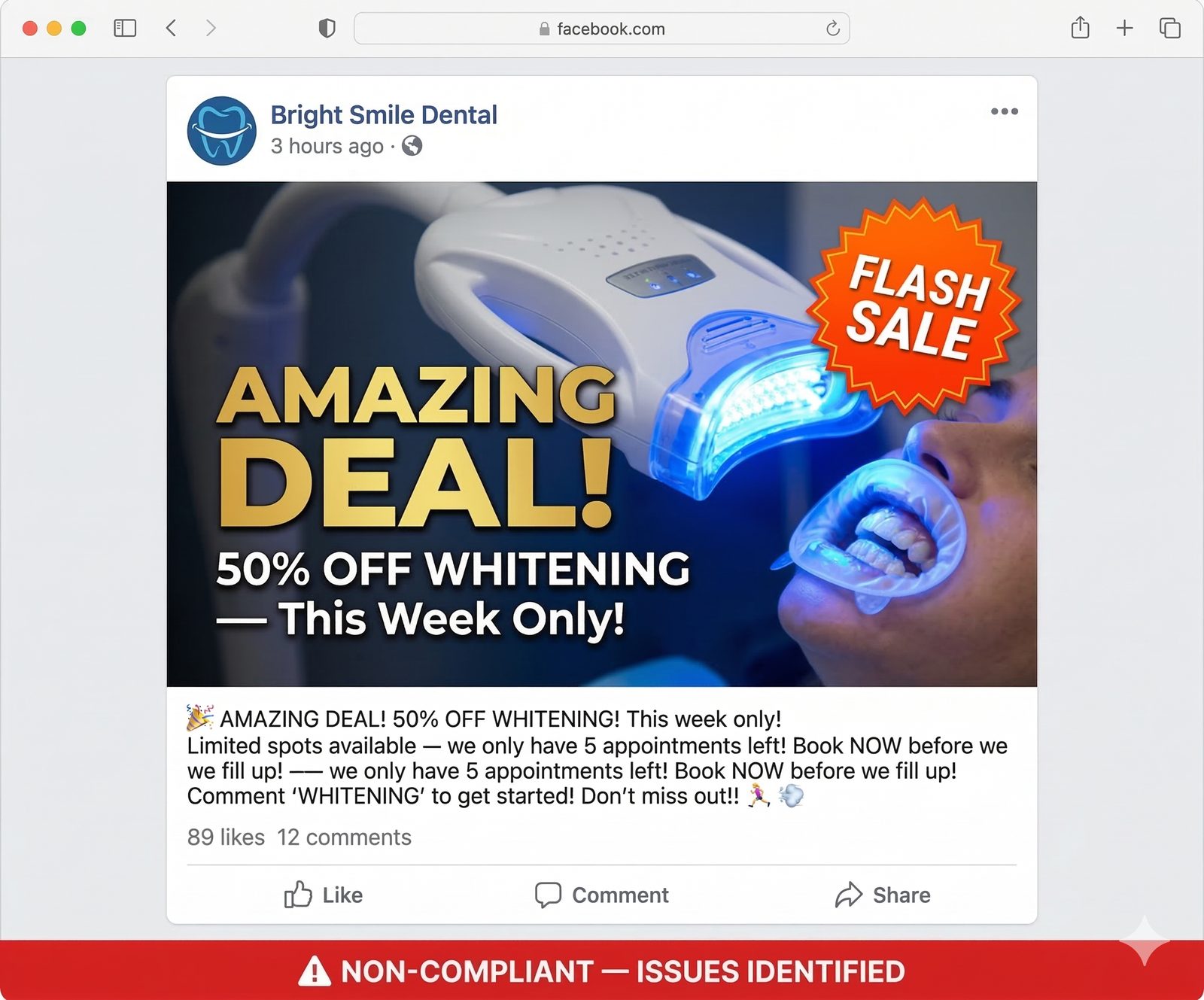
This Facebook post violates multiple advertising requirements:
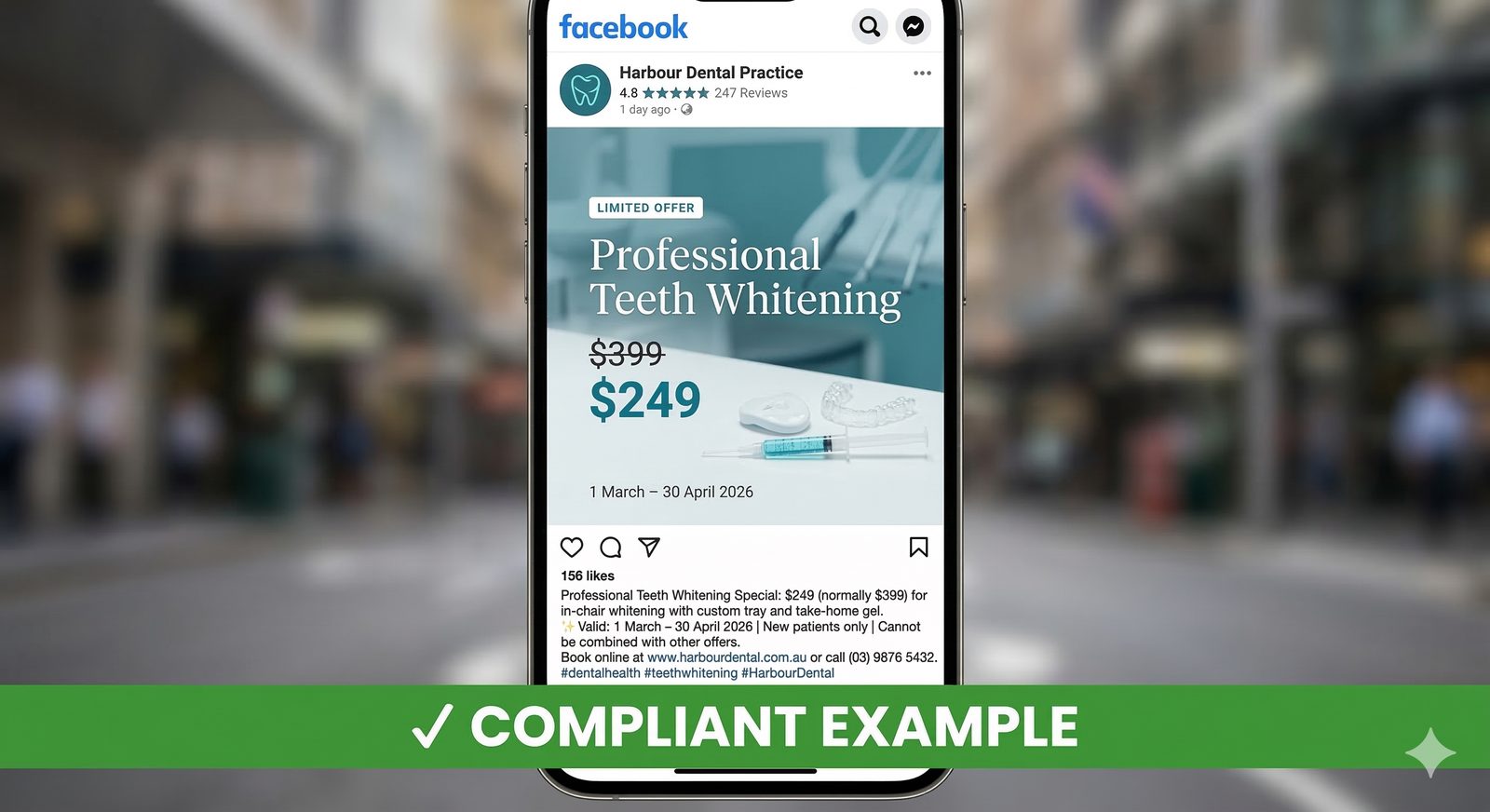
This revised version includes all required information:
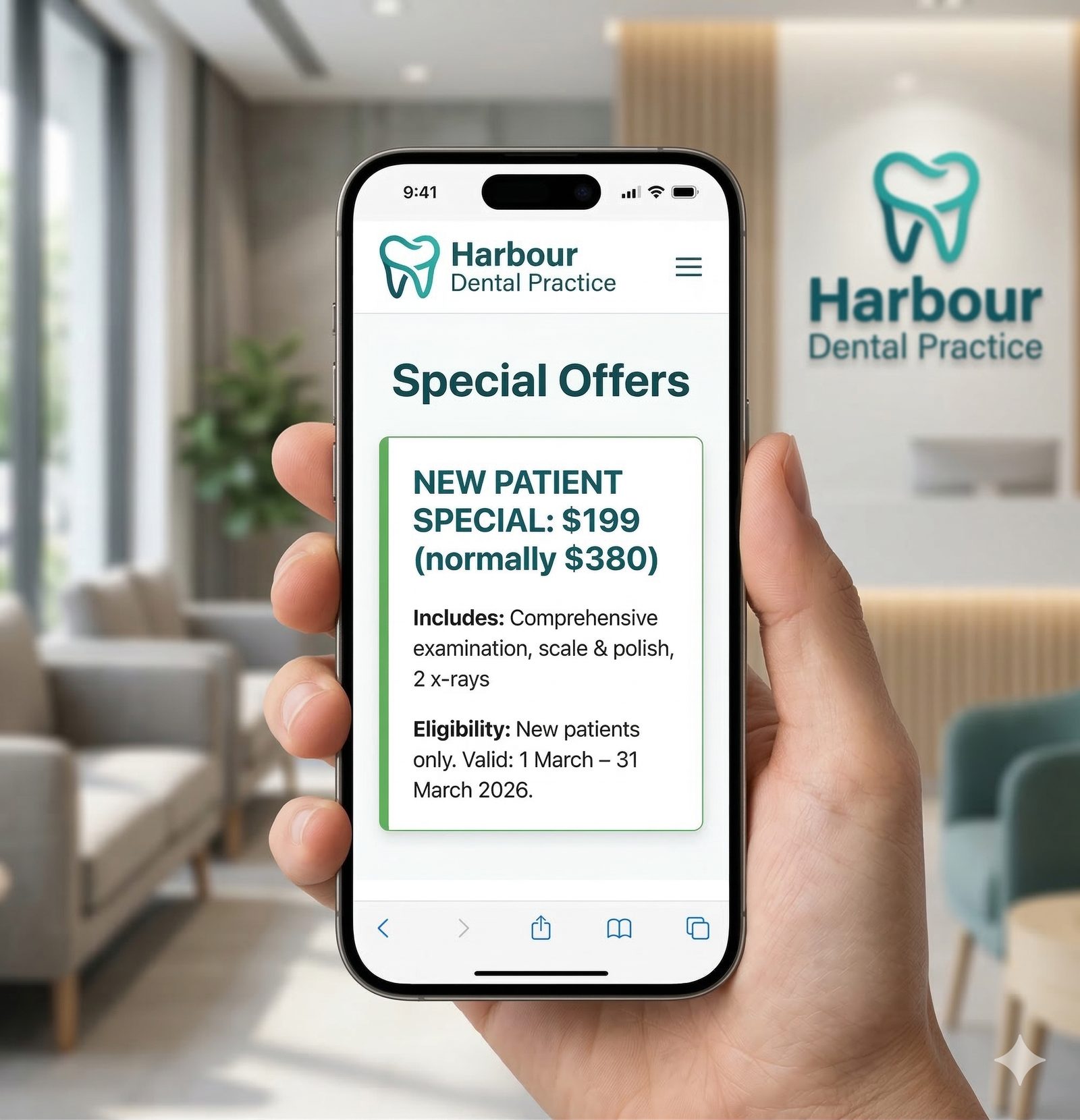
This promotion page demonstrates best practices:
Beyond the National Law, discounts and offers must also comply with Australian Consumer Law. The ACCC has taken action against businesses for "drip pricing" (advertising a headline price but then adding fees), bait advertising (advertising a deal that is not genuinely available), and misleading "was/now" pricing.
Key Takeaways: Module 7
- Discounts and offers are allowed, but only with full, clear terms and conditions stated in the advertisement.
- Terms must include: what's covered, eligibility, dates, exclusions, pricing, and any conditions.
- Referral programs, free consultations, and membership plans all need T&Cs.
- Consumer Law adds further requirements around drip pricing, bait advertising, and misleading pricing.
- Urgency and scarcity language risks breaching the prohibition on encouraging unnecessary use.
Before/After Photos & Visual Content
Navigating the strict rules around clinical photography in dental advertising.
Learning Objectives
- Explain the September 2025 ban on before/after photos for cosmetic procedures
- Describe the conditions under which before/after photos may be used for non-cosmetic procedures
- Identify the rules for stock photography, AI imagery, and video content
- Apply the visual content rules to common advertising scenarios
Before-and-after photos are one of the most powerful marketing tools available to dental practices and also one of the most heavily regulated. The rules tightened significantly with the September 2025 AHPRA guidelines.
The Current Rules (Post-September 2025)
For cosmetic dental procedures, the September 2025 guidelines introduced significant new restrictions on before-and-after imagery.
For procedures classified as cosmetic (including teeth whitening, veneers, and cosmetic bonding), before-and-after clinical photographs are now banned in advertising, even with patient consent. AHPRA has also specifically warned against AI-generated or digitally manipulated comparisons that may create unrealistic expectations.
General Dental Procedures: Conditional Use
For non-cosmetic dental procedures, before-and-after photos are not outright banned, but they must comply with strict conditions if used:
- Photos must be of real patients of the practitioner: no stock photos or photos from other practitioners
- Photos must not feature minors (under 18)
- Presentation must be realistic: same lighting, same angle, same camera settings
- The "after" image must not be the most prominent element of the advertising
- A disclaimer must state that results vary between patients
- Separate, informed consent must be obtained specifically for use of the photos in advertising
- Photos must not be digitally enhanced or filtered to exaggerate results
Other Visual Content Rules
Stock Photography
Using stock photos of smiling models is generally acceptable for general practice advertising, but becomes problematic if the images imply specific treatment outcomes.
AI-Generated Imagery
The September 2025 guidelines specifically address AI-generated or digitally manipulated images. "Smile simulations" or AI-predicted outcomes should not be used in advertising if they could create unreasonable expectations.
Video Content
Video content (including TikTok videos, YouTube, and Instagram Reels) is subject to all the same rules. A video showing a patient's "smile transformation journey" would constitute both a testimonial and potentially non-compliant before/after imagery.
Visual Examples
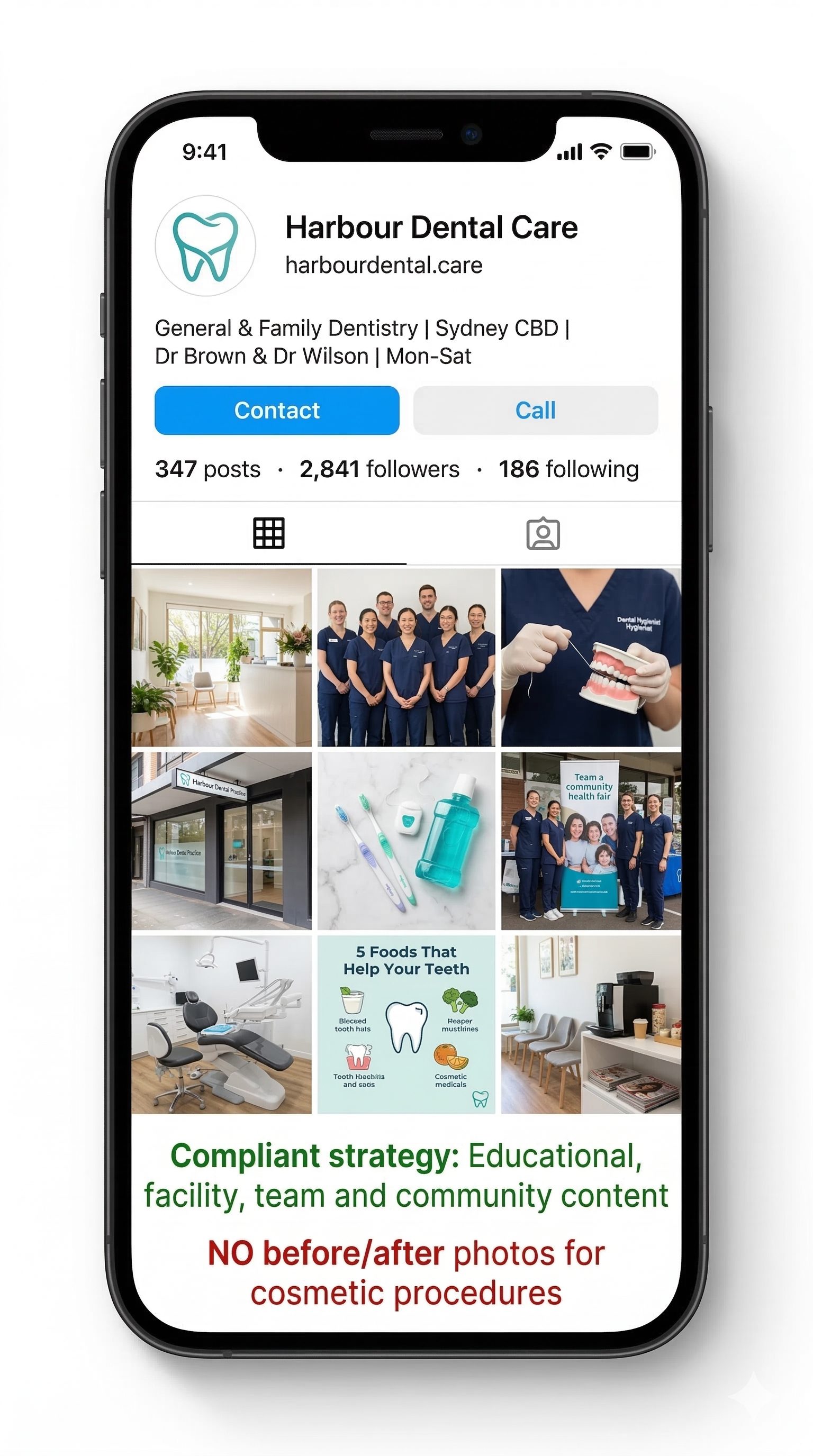
✗ Non-Compliant Before/After
- Cosmetic procedure before/afters (banned)
- Different lighting/angles
- Digitally enhanced or filtered
- No disclaimer about variability
- AI-generated "smile simulation"
- Minor patient photos
✓ Compliant Approach
- Non-cosmetic clinical cases only
- Consistent lighting & angles
- No digital enhancement
- "Results vary by patient" disclaimer
- Real patient photos (adult only)
- Separate written consent
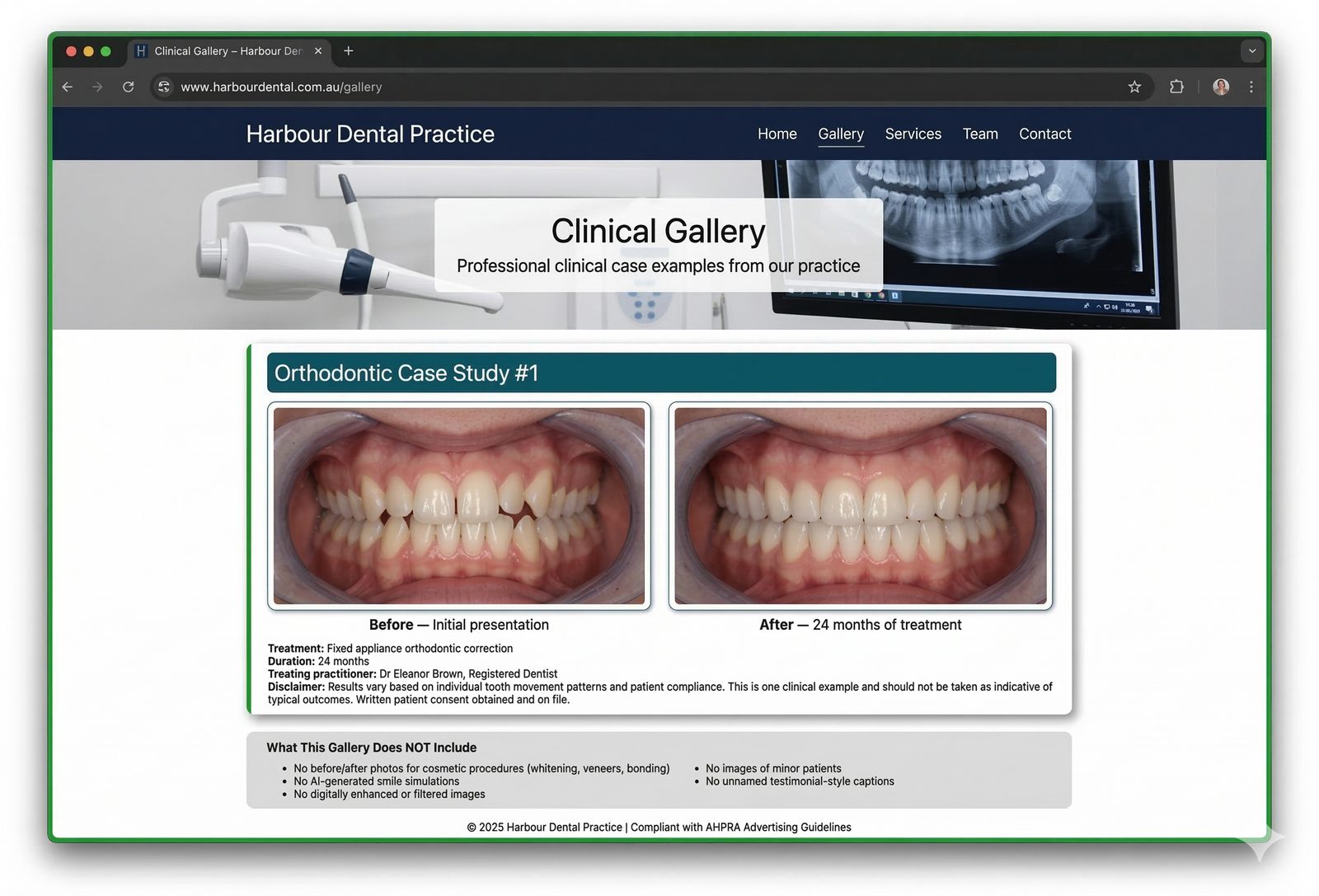
This gallery follows September 2025 guidelines:
A practice website features a "Gallery" page with professional photos of the practice interior, the dental team at work, and modern equipment. Service pages describe treatments in factual terms with appropriate disclaimers. The website does not include before/after photos for cosmetic treatments.
An Instagram account posts weekly before/after photos of veneer cases with the caption "Another beautiful smile transformation!" Photos show dramatic differences in lighting between before and after.
Key Takeaways: Module 8
- Before/after photos for cosmetic dental procedures are now banned in advertising (from September 2025).
- For non-cosmetic procedures, before/after photos are permitted under strict conditions: real patients, consistent imagery, results-vary disclaimers, and specific written consent.
- AI-generated or digitally manipulated images must not be used to create unrealistic expectations.
- Stock photos should not imply specific treatment outcomes.
- Video content is subject to all the same rules as static images.
Consumer Law & the ACCC
Understanding the additional layer of consumer protection law that applies to dental advertising.
Learning Objectives
- Explain Section 18 of the Australian Consumer Law and how it applies to dental advertising
- Describe the key differences between the National Law and the ACL
- Identify ACCC enforcement priorities and penalty levels
- Apply consumer law principles to pricing, comparative claims, and advertising transparency
In addition to the National Law and AHPRA guidelines, dental practices must also comply with Australian Consumer Law (ACL), which is enforced by the Australian Competition and Consumer Commission (ACCC).
The ACL applies to dental practices because they are businesses operating in trade or commerce. Its protections operate independently of and in addition to the National Law.
Section 18: Misleading or Deceptive Conduct
A person must not, in trade or commerce, engage in conduct that is misleading or deceptive or is likely to mislead or deceive.Australian Consumer Law, Section 18
The core prohibition is Section 18 of the ACL.
- No intention required: even an honest mistake is a breach if conduct is objectively misleading.
- Likelihood is enough: the conduct doesn't have to actually mislead; if it's likely to, that's sufficient.
- Overall impression matters: the law looks at the overall impression created, not just individual words.
- Silence can mislead: failing to disclose material information can be as misleading as making a false statement.
How the ACCC Applies This to Healthcare
The ACCC has been increasingly active in enforcing advertising standards in the healthcare sector. Their focus areas include misleading claims about treatment outcomes or efficacy, false or misleading pricing, bait advertising where advertised offers are not genuinely available, and misleading representations about qualifications or experience.
The SmileDirectClub Case
In 2021, the ACCC found that SmileDirectClub had misled approximately 26,300 Australian consumers. In 2022, SmileDirectClub was ordered to pay penalties totalling $3.5 million, in addition to compensating affected consumers and implementing a compliance program.
ACCC penalties can be dramatically higher than AHPRA penalties. For corporations, the maximum penalty for a breach of the ACL is the greater of $50 million, three times the value of the benefit obtained from the conduct, or 30% of the corporation's adjusted turnover. For individuals, the maximum penalty is approximately $2.5 million per contravention.
Practical Implications for Dental Practices
If you advertise a price for a service, the final price the patient pays should match the advertised price. "Drip pricing" (where additional fees are added during the booking or treatment process) is a breach of consumer law.
If you compare your practice or services to competitors (e.g., "cheaper than the national average"), you must have a reasonable basis for the comparison. Unsubstantiated comparisons are misleading conduct under the ACL.
Advertising that a service "was $500, now $350" requires that the service was genuinely offered at $500 for a reasonable period. Inflating the original price to make the discount appear more attractive is misleading under the ACL.
ACCC Enforcement Examples
How an ACCC Investigation Unfolds
Consumer complaint, competitor report, or ACCC routine monitoring identifies potentially misleading advertising (e.g. inflated "was" pricing).
The ACCC issues a compulsory information notice. The practice must provide pricing records, advertising materials, and documentation within 14 days. Non-compliance is a criminal offence.
ACCC investigators review whether the "was" price was genuinely offered for a reasonable period and whether the advertising would mislead an ordinary consumer.
Ranges from infringement notices and court-enforceable undertakings to Federal Court proceedings with penalties up to $50 million for body corporates.
Source: ACCC media release, 11 November 2022. "SmileDirectClub to pay $3.5m for misleading claims"; ACL maximum penalties per Competition and Consumer Act 2010 (as amended November 2022).
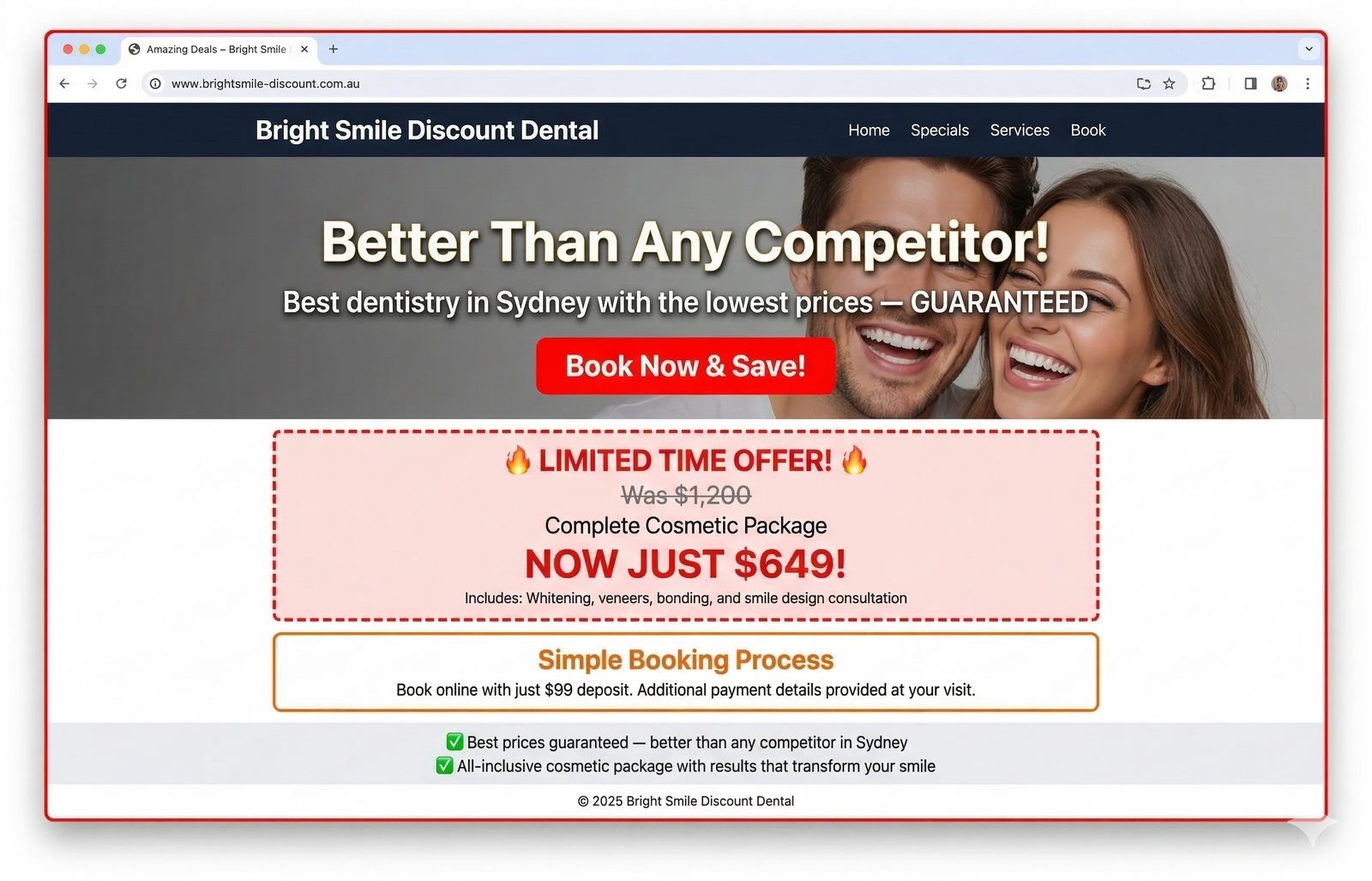
This website breaches multiple consumer protection laws:
The TGA: Therapeutic Goods
The Therapeutic Goods Administration regulates advertising of therapeutic goods, which includes certain dental products. For dental practices, the key relevance is that teeth whitening products above certain concentrations are classified as therapeutic goods, and advertising claims about specific dental products must be consistent with the product's approved indications.
Teeth whitening is both a Regulated Health Service (governed by AHPRA/National Law) and involves Therapeutic Goods (governed by the TGA). Advertising it requires compliance with both frameworks simultaneously.
✗ The "TGA Trap"
- Banned Words: "Safe," "Effective," "Painless."
- Brand Names: Using specific product names (e.g., "Zoom") in consumer-facing ads.
- Minor Target: Targeting or featuring anyone under 18.
✓ The Compliant Way
- Mandatory Statement: "Always read the label and follow directions."
- Risk Disclosure: "Consult your dentist to see if this treatment is right for you."
- Concentration: Only registered practitioners can supply products >6% H2O2.
Key Takeaways: Module 9
- Australian Consumer Law (Section 18) prohibits misleading or deceptive conduct. No intention is required.
- The ACCC enforces consumer law independently of AHPRA.
- ACCC penalties can be dramatically higher than AHPRA penalties (up to $50 million for corporations).
- Pricing must be transparent: no drip pricing, no inflated "was/now" comparisons, no bait advertising.
- The TGA adds another layer for practices that advertise specific dental products or therapeutic goods.
Real-World Scenarios & Case Studies
Apply your knowledge to realistic advertising situations dental practices face every day.
Learning Objectives
- Apply knowledge from all previous modules to realistic advertising scenarios
- Identify multiple simultaneous compliance issues in a single piece of advertising
- Evaluate whether specific advertising copy, social media posts, and promotional materials are compliant
Now that you understand the rules, let's put them into practice. This module presents realistic scenarios based on common situations dental practices encounter.
Scenario 1: The New Practice Website
Scenario 2: The Instagram Reel
Scenario 3: The Google Ads Campaign
Real-World Advertising Examples
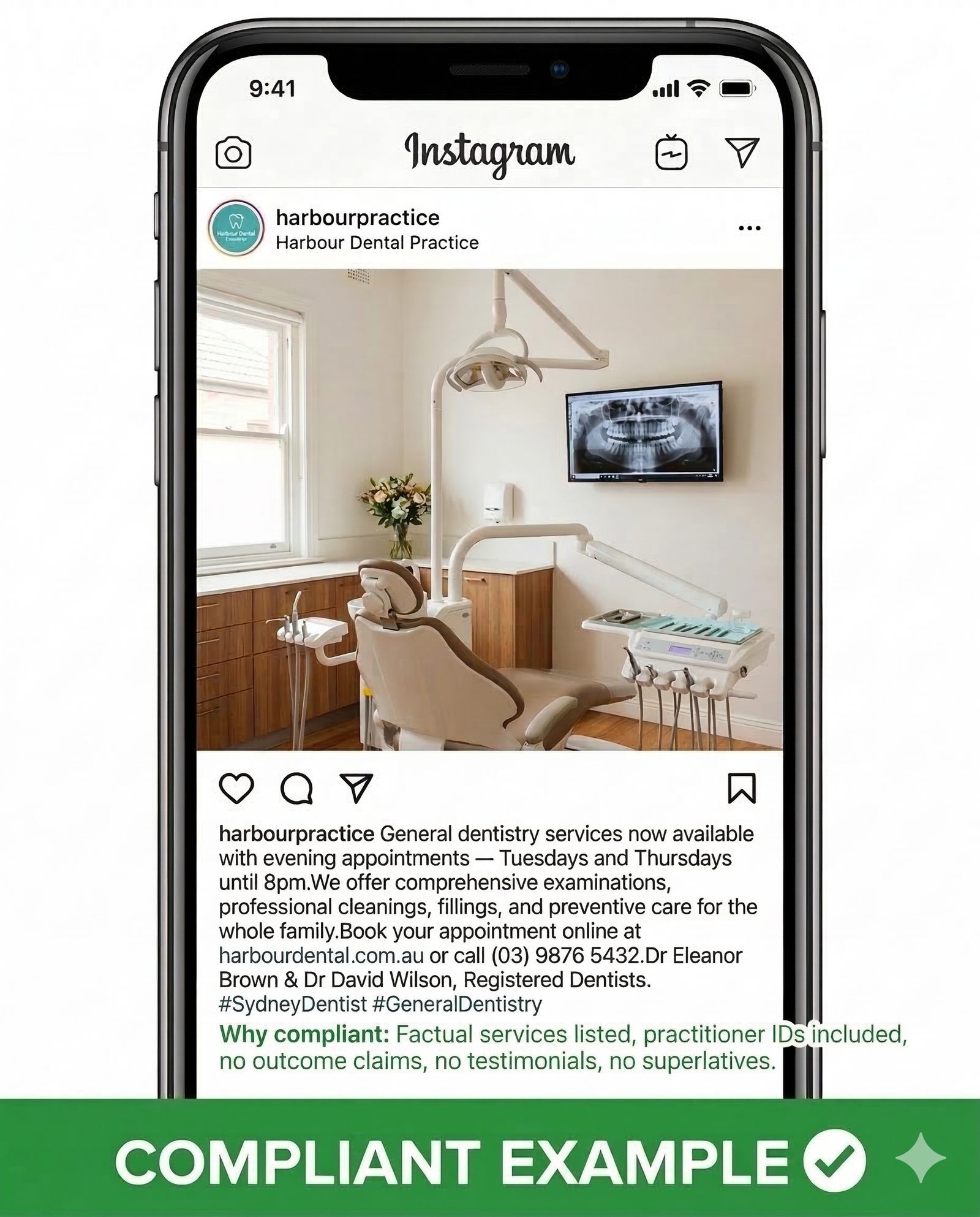
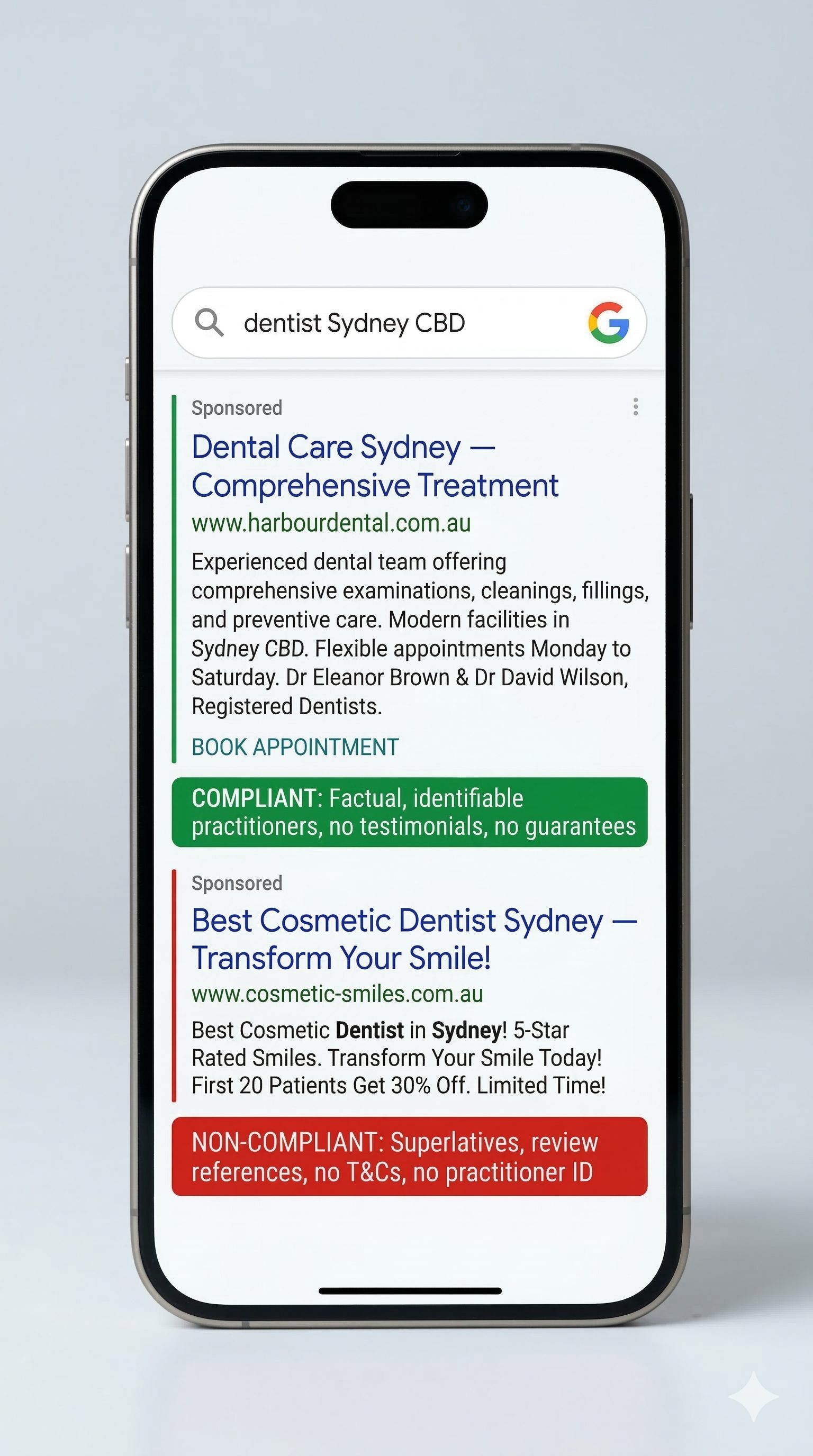
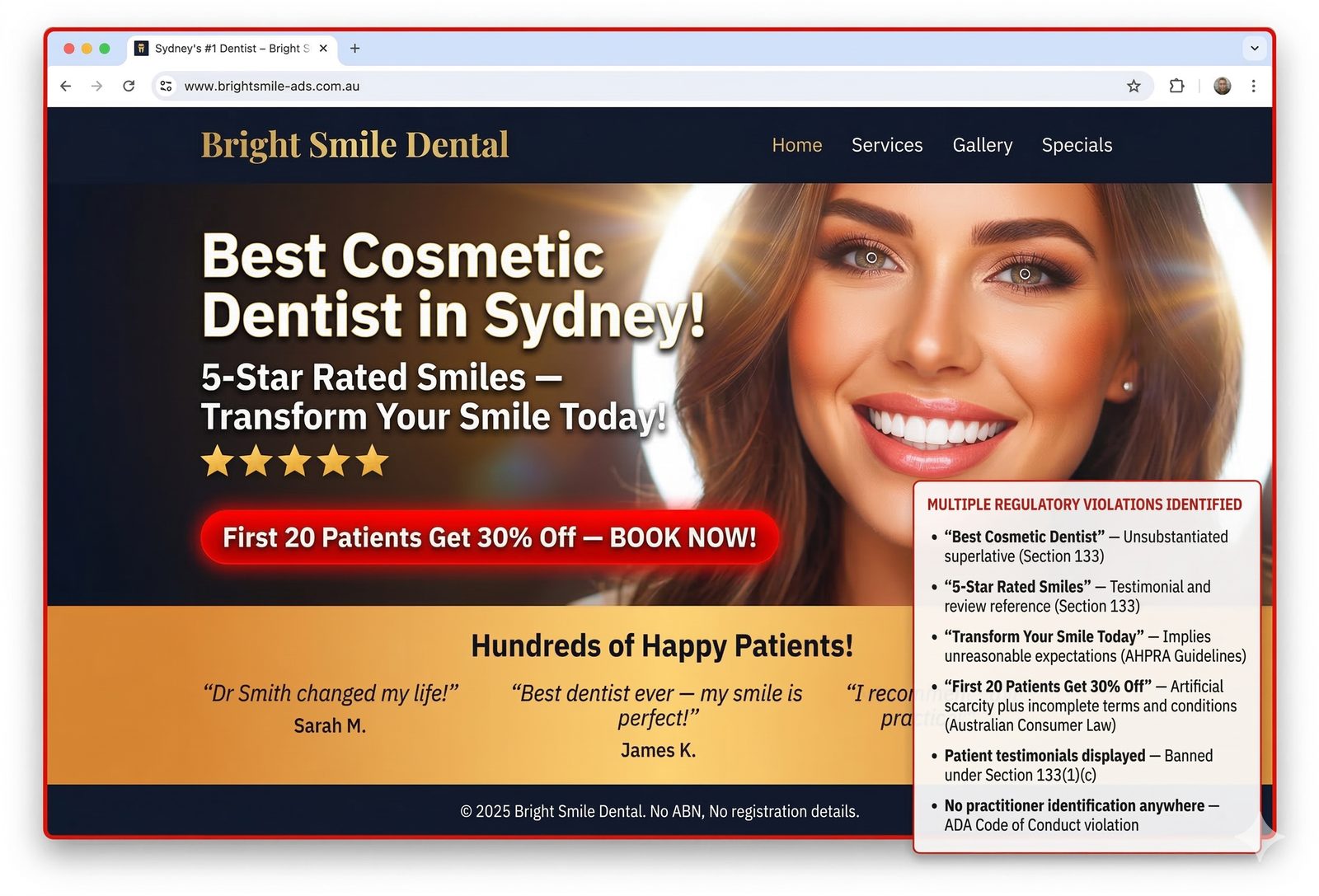
This advertisement violates multiple rules across different regulatory frameworks:
Scenario 4: The Patient Referral Program
Scenario 5: The Practice Newsletter
Scenario 6: The SEO Meta Description
Scenario 7: The Patient Recall SMS
Scenario 8: The Reception Script
Scenario 9: The Clinic Window Display
Key Takeaways: Module 10
- Most non-compliant advertising involves multiple simultaneous breaches, not just one.
- Always review advertising through the lens of all five Section 133 prohibitions, plus consumer law, before publishing.
- Common traps include: superlative claims ("best", "top-rated"), urgency language, referencing reviews, and insufficient terms for offers.
- Every piece of advertising needs the same level of compliance review.
Your Compliance Checklist
A practical, step-by-step checklist to review every piece of advertising before you publish it.
Learning Objectives
- Use the pre-publication compliance checklist to review advertising
- Establish a compliance review process within a dental practice
- Identify key resources for staying up to date with advertising regulations
This module provides you with a practical tool: a compliance checklist that you can use every time you create, review, or approve advertising for your dental practice. Print it out, save it, and make it part of your standard workflow.
The Pre-Publication Checklist
Before any piece of advertising goes live, whether it's a website update, a social media post, a Google Ad, a brochure, or a newsletter, run it through each of these checks:
1. TRUTHFULNESS AND ACCURACY
- ☐ Is every statement in the advertisement factually accurate?
- ☐ Could any statement be interpreted as misleading, even if technically true?
- ☐ Are all clinical claims supported by acceptable scientific evidence?
- ☐ Does the advertisement avoid creating an unreasonable expectation of results?
- ☐ Does the overall impression (not just individual words) accurately represent your services?
2. TESTIMONIALS AND REVIEWS
- ☐ Does the advertisement avoid using any patient testimonials about clinical care or outcomes?
- ☐ If patient reviews are referenced, do they relate only to service experience (not clinical outcomes)?
- ☐ Are there no patient stories, quotes, or endorsements relating to treatment results?
- ☐ Are there no influencer endorsements (especially for cosmetic procedures)?
3. OFFERS AND INDUCEMENTS
- ☐ If a discount, gift, or offer is advertised, are the full terms and conditions clearly stated?
- ☐ Do the T&Cs include: what's covered, eligibility, dates, exclusions, and pricing?
- ☐ Is any "was/now" pricing based on genuine previous pricing?
- ☐ Is the offer genuinely available (not bait advertising)?
4. TITLES AND CLAIMS
- ☐ Are only correct protected titles used for each practitioner?
- ☐ Is the word "specialist" (or variations) only used for practitioners with specialist registration?
- ☐ Is "Dr" only used for dentists and specialist dentists?
- ☐ Does the advertisement identify the practitioner, their profession, and registration?
- ☐ Are qualifications listed accurately and not in a misleading way?
5. VISUAL CONTENT
- ☐ If before/after photos are used, is the procedure non-cosmetic?
- ☐ Do any before/after photos meet all requirements (real patients, consistent imagery, disclaimers, consent)?
- ☐ Are there no before/after photos for cosmetic procedures?
- ☐ Are there no images of minors in cosmetic-related advertising?
- ☐ Are any stock images used appropriately (not implying specific outcomes)?
6. UNNECESSARY USE
- ☐ Does the advertisement avoid urgency/scarcity language that could pressure patients?
- ☐ Does it avoid trivialising dental procedures?
- ☐ Does it avoid encouraging patients to seek treatment they may not need?
7. CONSUMER LAW
- ☐ Is pricing transparent (no hidden fees or drip pricing)?
- ☐ Are any comparative claims substantiated?
- ☐ Would a reasonable consumer understand the advertisement accurately?
If you work with a marketing agency, web designer, or social media manager, use this briefing template to communicate the advertising rules they must follow. It summarises all five Section 133 prohibitions, the September 2025 cosmetic rules, title restrictions, TGA requirements, and includes a pre-approval checklist and sign-off section.
Download the Advertising Briefing Template for Marketing Agencies (PDF)
Compliance Process Flowchart
Common Compliance Mistakes & Frequency
The following figures are from Jensen et al. (2023), an audit of 192 general dental practice websites published in the Australian Dental Journal. Percentages represent the proportion of websites found to contain each type of breach.
❌ Before Compliance Review
- Ad copy written by marketing staff
- No formal review process
- Before/after photos used freely
- Discounts posted without T&Cs
- Testimonials included casually
- No documentation of changes
✓ After Compliance Review
- Designated compliance reviewer
- Mandatory checklist before publishing
- Before/afters approved case-by-case
- All offers include full T&Cs
- Testimonials removed or reframed
- Compliance log maintained
Building a Compliance Culture
Assign one person (ideally a senior dentist or practice manager who has completed this course) as the advertising compliance reviewer. Every piece of advertising must be approved by this person before publication.
If you use an external marketing agency, provide them with a copy of this checklist and a briefing on the key rules. Many marketing agencies are not familiar with healthcare advertising restrictions. Make compliance part of your contractual arrangement.
Review your existing website, social media accounts, Google Business Profile, printed materials, and any other advertising. Use the checklist above to identify and correct any non-compliant content. This is particularly important following the September 2025 guideline changes.
If you receive a notification from AHPRA about advertising, treat it as urgent. Respond promptly, cooperate fully, and make corrections within the timeframe given. Demonstrating good faith and prompt action is a significant mitigating factor.
Resources and Further Reading
| Resource | Where to Find It |
|---|---|
| AHPRA Advertising Hub | ahpra.gov.au: Resources → Advertising Hub |
| AHPRA Advertising Guidelines | ahpra.gov.au: Advertising Guidelines and Other Guidance |
| Dental Board of Australia: Advertising | dentalboard.gov.au: Codes & Guidelines → Advertising |
| ADA Policy Statement 6.9 | ada.org.au: Policies → Dental Practice |
| ADA Advertising Compliance | ada.org.au: Explore → Topics → Advertising Compliance |
| ACCC: Advertising and Selling | accc.gov.au: Business → Advertising and Selling |
| National Law (Section 133) | austlii.edu.au: Search "Health Practitioner Regulation National Law" |
Key Takeaways: Module 11
- Use the pre-publication checklist for every piece of advertising, no matter how small.
- Designate a compliance reviewer and make approval mandatory before publication.
- Brief your marketing team or agency on the rules. They are not necessarily familiar with healthcare advertising restrictions.
- Audit your existing advertising against the current guidelines, especially following the September 2025 changes.
- If AHPRA contacts you, respond promptly and cooperatively.
Your State or Territory
Jurisdiction-specific guidance for advertising compliance in your state or territory.
Learning Objectives
- Understand how advertising regulation is administered in your specific state or territory
- Identify any additional state or territory requirements beyond the National Law
- Know where to find jurisdiction-specific guidance and support
Dental Practitioners in Australia
The Dental Board of Australia publishes quarterly registrant data tables with current registration numbers by state, territory, and division. For up-to-date figures, visit dentalboard.gov.au/Statistics.
✓ National Framework (All States)
- Health Practitioner Regulation National Law
- AHPRA Advertising Guidelines
- Dental Board of Australia standards
- Australian Consumer Law (ACCC)
- Therapeutic Goods Act (TGA)
- Same penalties across all jurisdictions
⭐ State/Territory Additions
- QLD: Health Ombudsman co-regulation
- Various state health department guidance
- State-specific registration requirements
- Local oral health priorities
- Territory-specific requirements (NT, ACT)
- Additional professional board policies
True or False: State & Territory Differences
Test your understanding of how dental advertising rules vary across Australian jurisdictions.
Each Australian state has completely different dental advertising laws.
State fair trading offices can take separate action on misleading dental advertising under Australian Consumer Law.
A dental practice advertising in multiple states must comply with the National Law in all of them.
AHPRA can only investigate complaints from the state where the practitioner is registered.
Please select your state or territory on the welcome screen to see jurisdiction-specific content.
Final Assessment
Test your knowledge across all modules. You need 70% to pass.
This assessment covers all 12 modules. Read each question carefully, select the best answer, and click "Submit Assessment" when you're done. You need to score at least 70% (7 out of 10) to pass.
Course Achievement Summary
Congratulations on Completing the Course!
You've completed all 12 modules and the final assessment. Remember: advertising compliance is an ongoing responsibility. Use the checklist from Module 11 every time you publish advertising, and stay up to date with AHPRA guidelines as they evolve.
This course was developed for educational purposes. For specific legal advice about your advertising, consult a healthcare lawyer.
This course is designed to support your continuing professional development obligations. While it is not a formally accredited CPD activity, the knowledge gained is directly relevant to your professional obligations as a dental practitioner. For specific legal advice about your advertising, always consult a healthcare lawyer. This course does not constitute legal advice.